
Zelensky Sacks Army Chief Syrsky After Days of Protests Over Military Reforms
By NEWSROOM STAFF · 22/07/2026 10:14 AM · 4 min read
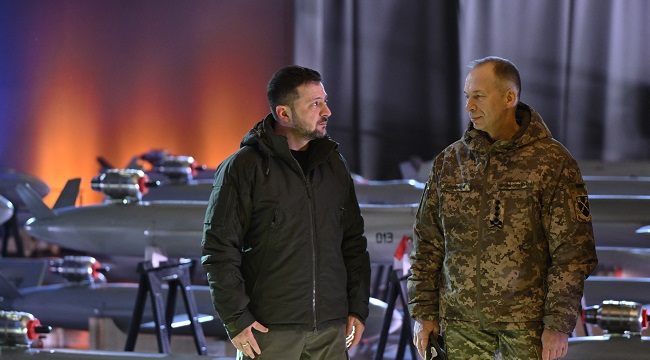
Ukrainian President Volodymyr Zelensky has removed Oleksandr Syrsky as Commander-in-Chief of the Armed Forces of Ukraine and appointed Joint Forces Commander Mykhailo Drapaty as his replacement, in a major shake-up of the country's military leadership.
The decision, announced by Zelensky on Tuesday, comes after days of political tension and public protests following the removal of Ukraine's popular Defence Minister Mykhailo Fedorov.
The latest leadership change has raised fresh questions about the direction of Ukraine's military strategy and ongoing efforts to reform the armed forces as the country continues its war against Russia.
Announcing the appointment, Zelensky said he had decided that Drapaty would become the country's new Commander-in-Chief.
“I have decided that the new Commander-in-Chief of the Armed Forces of Ukraine will be Mykhailo Drapaty,” Zelensky said in a statement posted on Telegram.
The Ukrainian president also thanked Syrsky for his service, saying he remained grateful to him and to Ukrainian troops for maintaining strong positions along the frontline.
Syrsky, 60, had served as Ukraine's top military commander since 2024 and was considered one of the country's most experienced battlefield commanders.
He played a prominent role in the defence of Kyiv during the early stages of Russia's full-scale invasion in 2022.
His departure comes amid growing controversy within Ukraine's political and military establishment following Zelensky's decision to remove Fedorov, a 35-year-old minister who had gained popularity for his efforts to modernise the country's defence sector.
Fedorov reportedly accused Syrsky of opposing his reform proposals and pressuring Zelensky to remove him. Syrsky denied the allegations.
The dispute subsequently exposed divisions within Ukraine's leadership at a sensitive period in the war, with questions emerging over military procurement, mobilisation, equipment and broader efforts to modernise the armed forces.
Drapaty, 43, is a decorated major general who previously commanded Ukraine's ground forces and has extensive combat experience.
He fought against Russian-backed separatists in eastern Ukraine during the conflict in the Donbas region and became known in Ukraine after footage emerged purporting to show him using an armoured vehicle to break through a separatist checkpoint in Mariupol in 2014.
Following his appointment, Drapaty thanked Zelensky for the confidence placed in him and described his new position as a major responsibility during the country's ongoing war.
“Serving Ukraine has always been an honour for me, and during the war for independence it means absolute responsibility,” Drapaty said in a statement posted on Facebook.
Fedorov welcomed the appointment, describing Drapaty's emergence as a potential turning point for Ukraine's military campaign.
“This is a breath of fresh air and a new hope in the struggle of free people for freedom and justice,” he said in a social media post.
The appointment followed protests across Ukraine after Fedorov was removed from office last week.
Demonstrators reportedly expressed concerns about the pace of military reforms and called for Syrsky to be replaced.
The protests reflected broader frustrations among sections of the public and military community over the handling of reforms, including procurement, equipment and mobilisation.
Syrsky's removal makes Drapaty the third Ukrainian commander-in-chief since Russia launched its full-scale invasion in February 2022.
The latest change also comes against the backdrop of a difficult and evolving battlefield.
While Ukrainian forces have sought to slow Russian advances in several areas, Kyiv has also intensified long-range strikes against targets inside Russia, including oil infrastructure that Ukrainian authorities say supports Moscow's war effort.
At the same time, both Russia and Ukraine have continued to intensify aerial attacks, while the United Nations has reported an increase in civilian casualties in Ukraine in recent months.
Analysts cited by AFP had previously suggested that Syrsky's position was not primarily threatened by political ambitions, particularly when compared with his predecessor, Valeriy Zaluzhny, whose popularity had been viewed as a potential political challenge to Zelensky before his removal.
However, Syrsky had faced criticism over his approach to military reforms and concerns about the scale of battlefield casualties.
Critics also accused him of slowing reforms in areas including defence procurement, military equipment and mobilisation, allegations that formed part of the wider debate over the direction of Ukraine's armed forces.
Zelensky's decision to replace him now places Drapaty at the centre of efforts to address those concerns while maintaining Ukraine's military position against Russia.
The new commander-in-chief will be expected to balance battlefield demands with pressure for institutional reform, improved military procurement and more effective mobilisation as the war continues.
The leadership change represents one of the most significant military shake-ups under Zelensky's presidency and comes at a time when Ukraine is seeking to sustain international support while strengthening its capacity to resist Russian military pressure.
AFP
Written by
Newsroom Staff
SkyHigh NewsHub correspondent.