
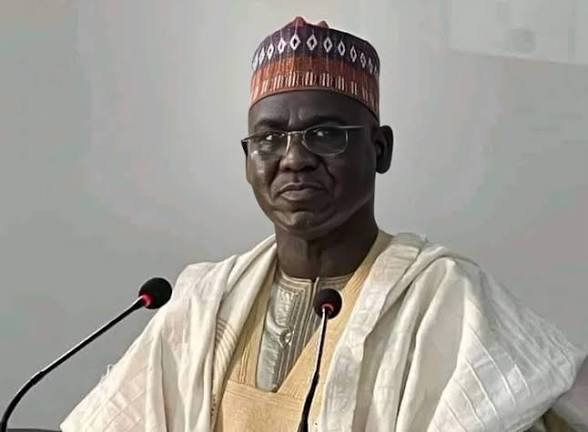
Politicians Fuel Insecurity, Benefit From Terror Activities, Buratai Alleges
By SKYHIGHNEWSHUB · 03/06/2026 7:29 AM · 3 min read
Former Chief of Army Staff and ex-Nigerian Ambassador to Benin Republic, Lieutenant General Tukur Buratai (retd.) has alleged that some politicians benefit from the activities of terrorists, bandits and kidnappers, blaming political interference and transitions in government for the persistence of insecurity across the country.
Buratai made the assertion during an interview on TVC News while reacting to the recent abduction of students and teachers in Oyo State and the broader security challenges confronting Nigeria.
According to him, the roots of many violent groups operating across the country can be traced to political actors who recruited and sponsored criminal elements for electoral purposes, only for such groups to eventually evolve into dangerous insurgent and bandit networks.
“Unfortunately, the plain truth is that some politicians benefit from the activities of these terrorists,” Buratai said.
The former Army chief argued that security challenges often escalate during periods of political transition, when changes in administration sometimes disrupt ongoing operations, affect funding cycles and create gaps that criminal organisations exploit.
He noted that insurgent groups appear to have developed a pattern of intensifying attacks whenever the country approaches major political activities or experiences a transition from one government to another.
“You discover that these terrorists or insurgents have a particular pattern, mainly when there are political activities or when there are transitions from one administration to the other,” he stated.
Buratai explained that such periods can temporarily affect the momentum of security operations, creating opportunities for criminal groups to regroup and launch attacks.
Speaking on the recent school abduction in Oyo State, the retired military officer urged Nigerians to appreciate the complexity of hostage rescue operations, stressing that the safety of abducted victims must remain the foremost consideration.
He cautioned against public pressure for immediate military offensives that could place hostages at greater risk, describing rescue missions as delicate operations that require patience, intelligence gathering and careful execution.
According to him, while security agencies possess the capacity to monitor communications and track criminal networks, every rescue operation must prioritise the preservation of human lives.
Buratai also reiterated his longstanding opposition to the payment of ransom to kidnappers, warning that such payments only strengthen criminal organisations and encourage further abductions.
“Paying ransom is very counter-productive,” he said, noting that ransom proceeds often provide criminal groups with resources to expand their operations and acquire more sophisticated weapons.
To address the country’s security challenges, Buratai advocated a comprehensive national strategy that goes beyond military deployments.
He called for the decentralisation of counter-terrorism efforts through the establishment of state-level branches of the National Security Adviser’s Counter-Terrorism Centre equipped with modern surveillance technology and operational capabilities.
The former military chief also urged government to increase recruitment into the armed forces and police, improve training programmes and provide better welfare packages for security personnel.
In addition, he advocated stronger engagement between government officials and communities affected by insecurity, arguing that frequent visits by political leaders and security authorities could help rebuild public confidence and strengthen cooperation with security agencies.
Buratai maintained that defeating terrorism, banditry and kidnapping would require a combination of political will, intelligence-driven operations, institutional reforms and decisive action against individuals who sponsor or profit from insecurity.
He stressed that sustainable peace would remain elusive unless political actors cease exploiting violence for personal or electoral advantage and governments at all levels work collaboratively with local communities to address the underlying causes of insecurity.
Written by
SkyhighNewshub
SkyHigh NewsHub correspondent.