
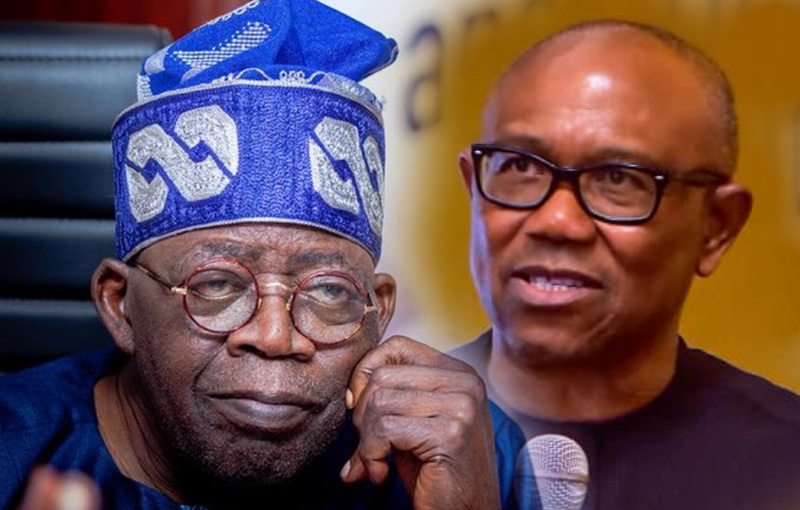
Obi Tells Tinubu to Step Aside Ahead of 2027, Says President's 'Best Is Not Enough'
By OZIOMA IWUH · 27/07/2026 9:18 AM · 6 min read
The presidential candidate of the Nigeria Democratic Congress (NDC), Peter Obi, has called on President Bola Tinubu to step aside ahead of the 2027 presidential election, arguing that the President no longer has the capacity required to address Nigeria's deepening economic and security challenges.
Obi made the call during an interview on Channels Television's Sunday Politics programme with Seun Okinbaloye, where he criticised the current state of the country and argued that Nigeria needed a new leadership capable of confronting its growing problems with greater urgency and commitment.
The former Anambra State governor acknowledged Tinubu's record as governor of Lagos State but maintained that, in his assessment, the President's performance at the national level had fallen short of what Nigeria currently requires.
"The Bola Tinubu that was governor is not the one that is president today. He's tired. He should be allowed to retire in peace, and then go home," Obi said.
He argued that Nigeria was "headed in the wrong direction" and needed a leader with the energy, capacity and commitment to reverse what he described as the country's worsening fortunes.
"As it is right now, Bola Tinubu is leading us nowhere. We will turn it so he can see it. That's why maybe I'm calling for his retirement. The man should just step aside. Yes, he doesn't have the capacity to do the job," he said.
Obi's comments come as the political landscape begins to take shape ahead of the 2027 presidential election, with economic hardship, insecurity, unemployment, education and the cost of living expected to remain major issues in the national debate.
The NDC candidate said the political conversation should focus less on personalities and more on the everyday challenges facing Nigerians.
He expressed concern over what he described as rising poverty, hunger, insecurity and the growing number of children who are out of school, arguing that these issues deserved greater attention from political leaders and the public.
According to Obi, figures he attributed to international organisations should serve as a warning about the scale of the country's challenges.
"World Bank has just said that 79% of Nigerians are going to face poverty. In a country of 230 million people, that's over 180 million. That should be the issue we should be discussing," he said.
He added that political leaders should be focusing on issues such as out-of-school children, healthcare and the alleged diversion or mismanagement of public funds that could otherwise be invested in critical sectors.
"They should be talking about the issue of out-of-school children, talking about the issue of health, and all these monies that are missing here and there that would have been invested properly. Nobody is discussing it," Obi said.
The former governor also raised concerns over food insecurity, citing a figure he attributed to the World Food Programme.
"This election in 2027 should be about issues that affect the ordinary Nigerians... The World Food Programme has just said 35 million Nigerians are going to face hunger. Nigerians are being kidnapped. Let's talk about Nigeria," he said.
'Tinubu's Best Is Not Enough'
Obi also responded to comments attributed to former United States President Donald Trump praising Tinubu's efforts in tackling insecurity.
While acknowledging the recognition, Obi insisted that the government's response to the security crisis remained inadequate, arguing that the scale of the problem required a much stronger intervention.
"Thank you to Donald Trump. Thank you to President Trump. But we need to do more, far more than what we are doing," he said.
Obi said he had heard people argue that the President was doing his best and suggested that Trump's comments reinforced that perception.
However, he maintained that the results on the ground were not sufficient given the severity of the challenges confronting Nigerians.
"I've heard people, and Donald Trump is now confirming it, say he has done his best. But with the crisis we are facing, his best is not enough. We need to do more," he said.
To underscore his concerns about insecurity, Obi referred to recent reports of mass abductions in Zamfara State.
"On Wednesday, 40 people were abducted in Zamfara, and the entire community, everybody is packing to run away. On Thursday, 50 were abducted. So we're in a crisis situation that requires another capacity," he said.
His comments came against the backdrop of persistent concerns over banditry, kidnapping and attacks in parts of northern Nigeria, with communities in several states continuing to face security threats that have disrupted livelihoods and forced residents to flee their homes.
'Poverty Fuels Insecurity'
Obi argued that the fight against insecurity could not be separated from the country's economic and social conditions.
According to him, widespread poverty and inadequate investment in education create conditions that can fuel criminality and make it more difficult for security agencies to contain insecurity.
"You can't create mass poverty and think you can deal with insecurity," he said.
"The more you put people out of poverty, the more you reduce criminality. You need to invest in education, massive."
The NDC candidate said any serious effort to address insecurity must therefore go beyond military and policing operations to include substantial investment in education, economic opportunities and human development.
He also promised a more hands-on approach to national security if elected President, saying the protection of citizens would be among his foremost responsibilities.
"Whatever it takes to secure any Nigerian, I will do that," Obi said.
"If your people are dying, you should be ready to die. You're the president. You're the number one person."
'I'm Desperate to See Nigeria Work'
Obi also sought to draw a distinction between his presidential ambition and what he described as a personal desire to see Nigeria succeed.
The former Anambra governor said his motivation for seeking the presidency was not simply to occupy the office but to contribute to building a country where citizens could live in peace and have access to opportunities.
"I'm not desperate to be Nigerian president. I'm desperate to see Nigeria work," he said.
He added that he would support any leader or initiative capable of producing positive results for the country, regardless of who was responsible for it.
"If it's working, I'll support whatever makes it work," Obi said.
Reflecting on Nigeria's current trajectory, he said he was saddened by what he described as a continuing decline in the country's social and economic conditions.
"Every year we're headed south, where more and more people have been impoverished, more and more children are out of school. Things are going in the wrong direction," he said.
Obi said his vision for Nigeria remained centred on building a united and peaceful country in which citizens would have equal opportunities regardless of their ethnic or religious backgrounds.
He argued that the 2027 election should therefore be a contest of ideas and policies, with political parties and candidates challenged to explain how they intend to address the problems confronting ordinary Nigerians.
The former governor's remarks are likely to further sharpen the political debate ahead of the 2027 presidential election, particularly as opposition figures intensify their criticism of the Tinubu administration's handling of the economy and security situation.
For Obi, however, the central issue remains what he describes as the urgent need to change the country's direction and restore hope to millions of Nigerians struggling with insecurity, poverty and limited opportunities.
Written by