
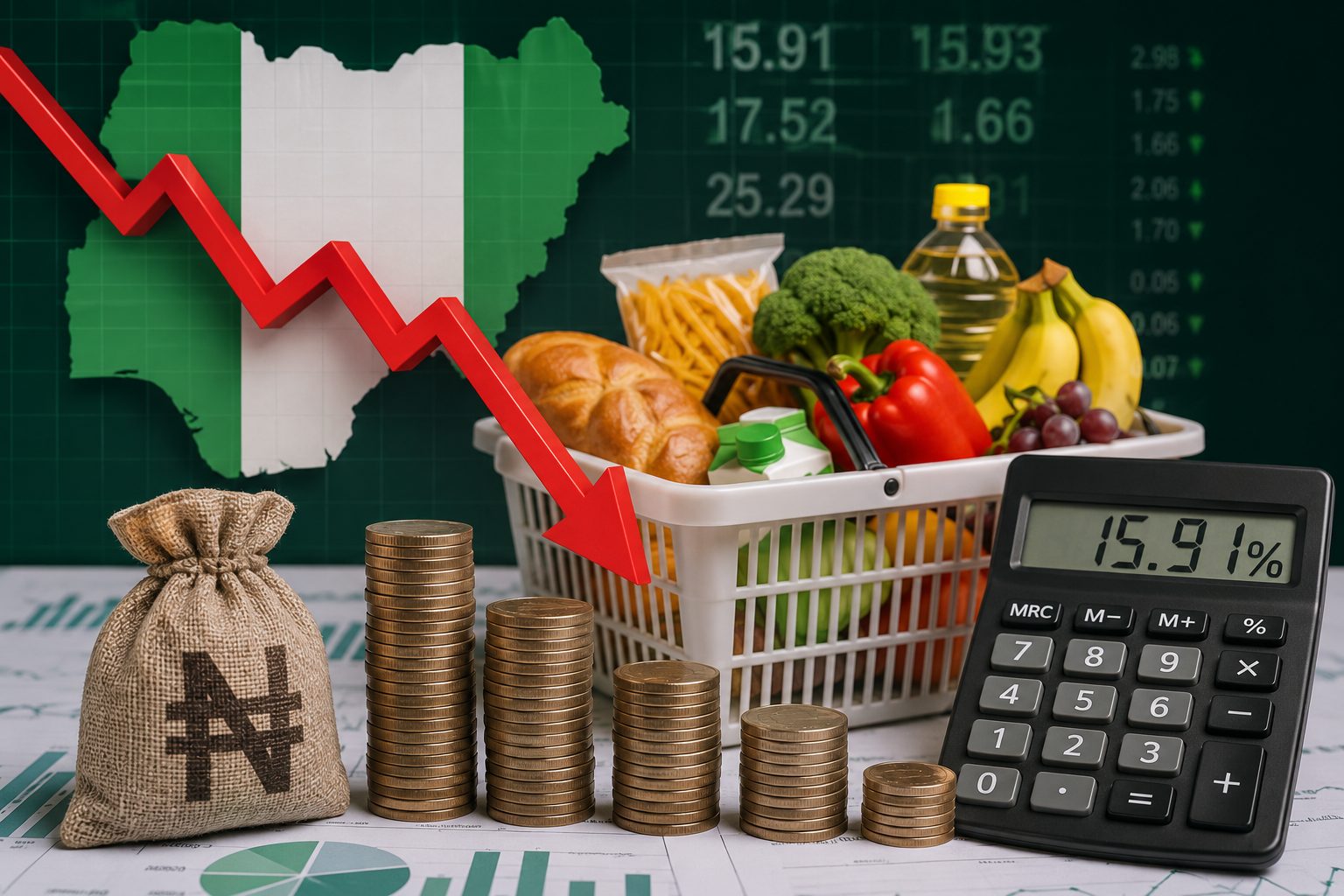
Nigeria’s Inflation Drops To 15.91% In June As Prices Ease Slightly
By OZIOMA IWUH · 16/07/2026 5:36 AM · 3 min read
Nigeria's headline inflation rate declined marginally to 15.91 per cent in June 2026, according to the latest Consumer Price Index (CPI) report released by the National Bureau of Statistics (NBS).
The figure represents a slight improvement from the 15.93 per cent recorded in May, indicating that the pace of consumer price increases continued to moderate.
The NBS also noted that June's inflation rate was significantly lower than the 25.29 per cent recorded in June 2025, reflecting a sharp year-on-year slowdown in overall price growth.
According to the report, the month-on-month headline inflation rate stood at 1.66 per cent in June, compared to 1.75 per cent in May, representing a decline of 0.09 percentage points.
Despite the moderation in headline inflation, food prices remained a major driver of inflationary pressure.
The NBS reported that food inflation stood at 17.52 per cent year-on-year, lower than the 25.41 per cent recorded in June 2025.
However, on a month-on-month basis, food inflation accelerated to 3.75 per cent in June from 2.98 per cent in May, reflecting continued increases in the prices of several essential food items.
According to the bureau, the increase was driven by higher prices of crayfish, fresh pepper, tomatoes, dried green peas, yam flour, water yam, beef, bananas, cassava flour, cowpeas, garri, Irish potatoes, yam tubers and other staple foods.
The report identified Food and Non-Alcoholic Beverages as the largest contributor to headline inflation, accounting for 6.37 percentage points. Restaurants and Accommodation Services contributed 2.06 percentage points, while Transport accounted for 1.70 percentage points. The smallest contributors were Recreation, Sport and Culture at 0.05 percentage points, Alcoholic Beverages, Tobacco and Narcotics at 0.06 percentage points, and Insurance and Financial Services at 0.07 percentage points.
Core inflation, which excludes the prices of volatile agricultural produce and energy, stood at 15.92 per cent year-on-year in June, down from 25.41 per cent recorded in the corresponding period of 2025.
On a monthly basis, core inflation eased to 1.66 per cent from 1.94 per cent recorded in May.
The NBS also said the average Consumer Price Index for the 12 months ending June 2026 increased by 18.82 per cent, compared to 26.88 per cent recorded during the corresponding period in 2025.
State-by-state analysis showed wide variations in inflation across the country.
On a year-on-year basis, Niger State recorded the highest headline inflation rate at 42.23 per cent, followed by Kogi at 41.59 per cent and the Federal Capital Territory at 39.91 per cent. The lowest annual inflation rates were recorded in Imo at 19.47 per cent, Ebonyi at 20.79 per cent and Katsina at 21.87 per cent.
On a month-on-month basis, Niger recorded the highest inflation increase at 11.65 per cent, followed by Katsina at 8.13 per cent and Kwara at 7.52 per cent. Meanwhile, Bayelsa recorded a decline of 6.48 per cent, Benue declined by 5.58 per cent, while Cross River fell by 5.12 per cent.
For food inflation, Kogi State posted the highest year-on-year rate at 53.02 per cent, followed by Niger at 43.83 per cent and Benue at 40.83 per cent. The slowest annual increases in food prices were recorded in Katsina at 19.15 per cent, Rivers at 23.81 per cent and Imo at 24.60 per cent.
On a month-on-month basis, Katsina recorded the highest food inflation rate at 16.82 per cent, followed by Kebbi at 9.79 per cent and Niger at 8.96 per cent. The lowest monthly food inflation rates were recorded in Borno at -3.54 per cent, Benue at -2.36 per cent and Bayelsa at -1.34 per cent.
The latest figures indicate that while overall inflation continues to moderate gradually, food prices remain under pressure, with significant differences in inflationary trends across Nigeria's states.
Written by
Ozioma Iwuh
SkyHigh NewsHub correspondent.