
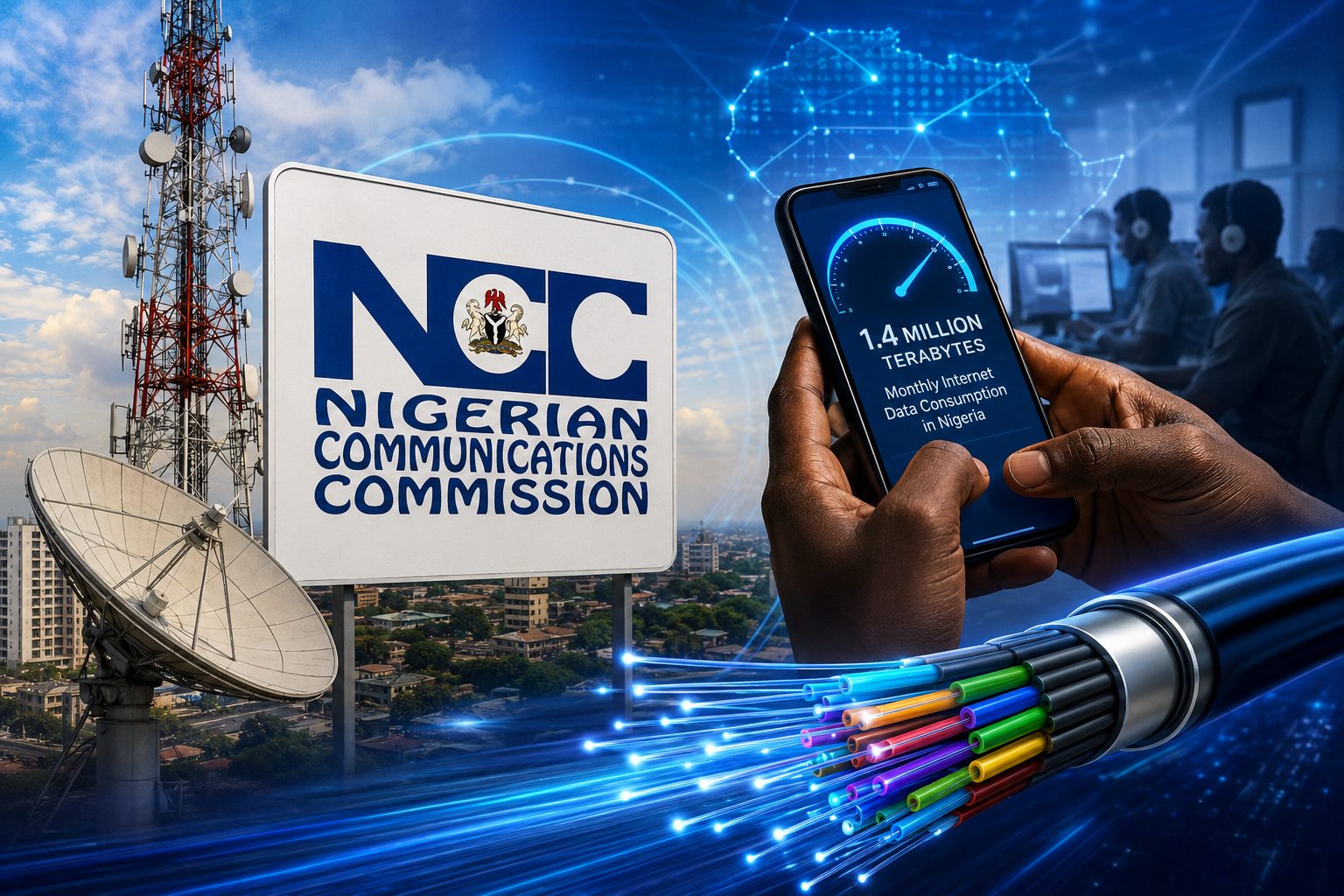
Nigerians Consume 1.4 Million Terabytes of Internet Data Monthly – NCC
By OZIOMA IWUH · 01/07/2026 8:32 AM · 3 min read
Nigerians are consuming an estimated 1.4 million terabytes of internet data every month, a dramatic increase being driven by the growing adoption of remote work, online learning, cloud computing and artificial intelligence (AI)-powered applications, the Nigerian Communications Commission (NCC) has disclosed.
The revelation highlights the country's rapidly expanding digital economy and reinforces the need for accelerated investment in broadband infrastructure to support rising internet demand.
Speaking virtually at the Association of Telecommunications Companies of Nigeria (ATCON) Critical Conversation Forum on Fibre-to-the-Home (FTTH) in Lagos on Tuesday, the Executive Vice Chairman of the NCC, Dr. Aminu Maida, said Nigeria's digital transformation is reshaping how citizens work, learn, conduct business and access public services.
"Nigerians now consume about 1.4 million terabytes of internet data monthly, driven by remote work, online learning, cloud services and AI-enabled applications," Maida said.
According to him, the surge in internet usage reflects the increasing role of digital technologies across virtually every sector of the economy.
Internet Subscribers Rise Above 154 Million
Maida disclosed that Nigeria recorded 154.72 million internet subscriptions as of April 2026, while broadband penetration climbed to 55.67 per cent, compared with 48.81 per cent recorded during the same period last year.
He said the figures demonstrate the country's steady progress toward a more digitally connected economy but warned that existing infrastructure must expand rapidly to keep pace with demand.
According to the NCC boss, broadband connectivity has become indispensable for education, healthcare, financial services, governance, commerce and innovation, making investment in resilient digital infrastructure a national priority.
Fixed Broadband Still Lags Behind
Despite the surge in internet usage, Maida noted that Nigeria's fixed broadband market remains underdeveloped.
He disclosed that the country currently has only about 265,000 Fibre-to-the-Home (FTTH) subscriptions, a figure he said presents enormous opportunities for investment and expansion.
He stressed that extending fibre connections directly to homes, schools, hospitals and businesses would improve internet quality while supporting Nigeria's ambition of building a $1 trillion economy.
NCC Calls for Faster Fibre Rollout
The telecom regulator used the occasion to renew its call for accelerated nationwide deployment of fibre infrastructure, saying stronger broadband networks are essential to sustaining the country's digital growth.
Maida identified Right-of-Way bottlenecks, multiple regulatory approvals, infrastructure vandalism, poor deployment standards and weak coordination among stakeholders as major obstacles slowing broadband expansion.
According to him, 13 states have abolished Right-of-Way charges for fibre deployment, while 16 others now implement the National Economic Council's approved rate of N145 per linear metre.
He urged the remaining states to remove unnecessary barriers, arguing that expanding digital infrastructure would generate far greater long-term economic value than revenue earned from Right-of-Way charges.
Telecom Infrastructure Under Pressure
Maida also raised concerns over persistent attacks on telecommunications infrastructure across the country.
He disclosed that operators recorded more than 27,685 fibre cuts, 27,000 access denials, and 4,210 incidents of theft in 2025, disruptions that significantly affected network reliability and service delivery.
He said stronger collaboration among governments, security agencies, telecommunications operators and host communities is essential to protect digital infrastructure, particularly following its designation as Critical National Infrastructure.
90,000 Kilometres of Fibre Planned
The NCC boss highlighted the Federal Government's Project BRIDGE, an ambitious initiative aimed at deploying about 90,000 kilometres of fibre-optic cable across Nigeria's 774 local government areas.
He explained that while expanding the national fibre backbone is important, the success of the project will depend on extending high-speed fibre connections to homes, schools, hospitals and businesses through last-mile Fibre-to-the-Home deployment.
Written by
Ozioma Iwuh
SkyHigh NewsHub correspondent.