
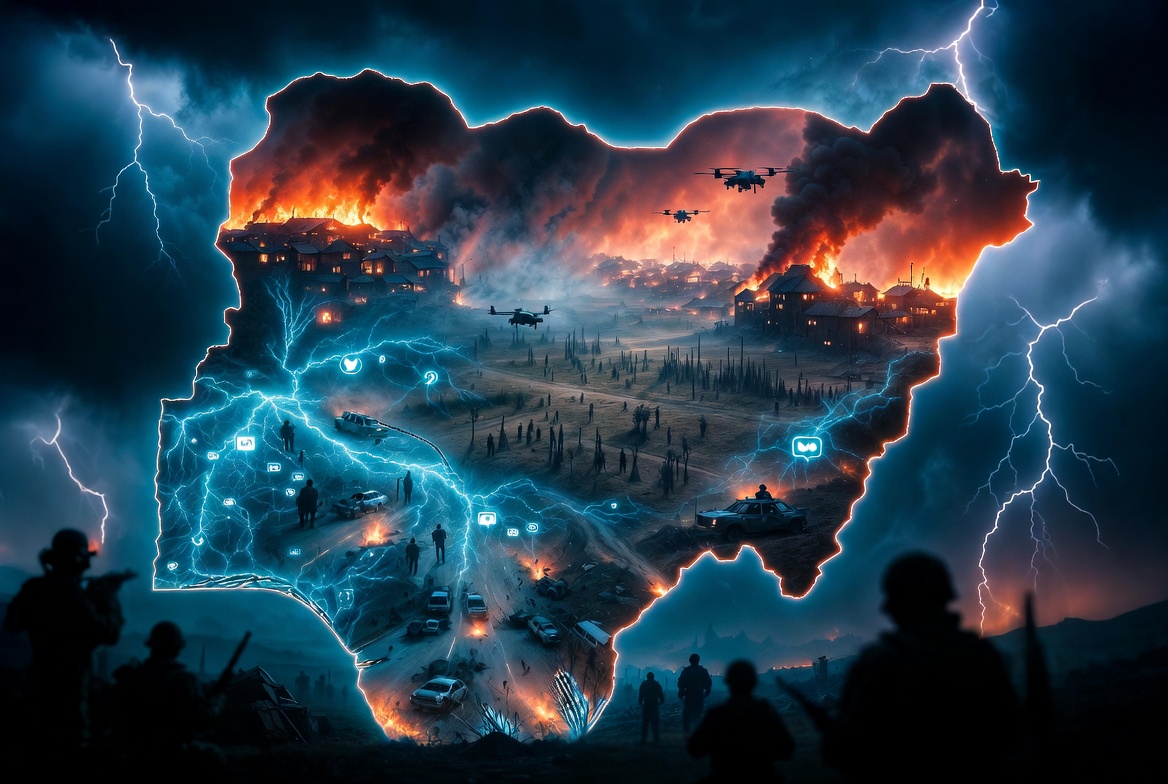
Nigeria’s Endless Insecurity: Fighting Twenty-First Century Threats with Twentieth-Century Tools
By CAPT. BISHOP C. JOHNSON, US ARMY (RTD) · 09/06/2026 10:30 AM · 7 min read
Nigeria is bleeding out. Villages vanish in nocturnal infernos. Families are torn apart by ruthless kidnappings. Highways have become slaughter zones. Once-thriving farmlands now lie desolate as terrified farmers flee invisible enemies. This is no ordinary “insecurity.” It is a relentless, merciless siege, a hybrid monster devouring the soul of Africa’s most populous nation from within. Yet, while our foes master the dark arts of modern conflict, we stubbornly cling to outdated conventional tactics, rigid doctrines, and a battlefield mindset that belongs to wars long past.
The enemies are no longer simple insurgents waving flags on open fields. In the Northwest, bandits fuse criminal enterprise with terror tactics, plundering resources while spreading panic. In the Northeast, evolved factions like ISWAP deploy drones, encrypted communications, sophisticated propaganda, and international networks. Separatist movements, deadly farmer-herder clashes, urban crime syndicates, and porous borders feed into a chaotic web of violence. These hybrid warriors blur every line: part criminal, part fanatic, part phantom. They do not just attack bodies; they hack minds through social media, bankroll chaos with oil theft and ransom empires, and weaponize ethnic and religious divisions. They operate in the gray zone where traditional armies falter, striking fast and melting away before the state can respond with little more than press releases and scattered operations.
The toll is catastrophic: thousands massacred, millions displaced, an economy hemorrhaging billions as the world watches Africa’s giant stagger in its own backyard. Our response? We deploy battalions as if facing old-school conventional armies. We hunt visible targets while shadowy networks recruit, radicalize, and resupply undetected. Intelligence failures run deep. Agencies clash in bureaucratic turf wars. Borders remain sieves. And too often, political leadership drowns in denial, finger-pointing, and short-term political theater.
Our troops display legendary bravery, but they fight with one hand tied behind their backs, chained by strategies that no longer match the threat. Hybrid warfare demands hybrid solutions: cyber capabilities, grassroots intelligence networks, aggressive disruption of terrorist financing, powerful counter-narratives to reclaim minds, and nimble special forces backed by real-time technology. Not endless checkpoints and reactive raids that generate headlines but fail to deliver lasting peace.
The stakes could not be higher. Without radical change, entire generations will be lost, national unity shattered, and Nigeria’s immense potential; its youthful dynamism, abundant resources, and resilient spirit forever chained by this persistent darkness. The hybrid war rages on. The battlefield has transformed. Our thinking must evolve with it or watch the endless night consume the dawn. Nigeria stands at the precipice. The time for bold, intelligent, unrelenting transformation is now. The survival of a nation depends on it.
For centuries, warfare was largely understood as a contest between states fought on clearly defined battlefields. Armies confronted one another across frontlines, seeking victory through superior manpower, firepower, logistics, and military strategy. The outcomes of wars were often determined by decisive battles, territorial conquest, and the destruction of an adversary’s military capabilities.
The twenty-first century has fundamentally altered this reality. Today, wars are no longer confined to physical battlefields. Conflict now extends into cyberspace, financial markets, social media platforms, communication networks, urban centers, and even the minds of populations. The traditional distinction between war and peace has become increasingly blurred. States and non-state actors alike employ a combination of military and non-military instruments to achieve strategic objectives without necessarily engaging in conventional warfare.
Modern conflicts are characterized by ambiguity, complexity, and adaptability. A small insurgent group equipped with commercial drones, encrypted communications, and social media platforms can challenge the authority of a state. Cyberattacks can cripple critical infrastructure without a single shot being fired. False information can undermine public trust and destabilize governments more effectively than conventional military attacks.
The battlefield of today is no longer defined by geography alone. It is defined by connectivity, information, technology, and influence. The age of “war without frontlines” has arrived.
Few nations illustrate the complexities of this new battlefield better than Nigeria.
As Africa’s most populous nation and one of its largest economies, Nigeria occupies a strategic position on the continent. Yet the country faces an array of security challenges that transcend traditional military threats. These include terrorism, insurgency, banditry, kidnapping, piracy, cybercrime, separatist agitations, transnational organized crime, and information warfare.
The emergence of groups such as Boko Haram and the Islamic State West Africa Province (ISWAP) demonstrated that non-state actors can challenge the authority of the state, control territory, disrupt economic activity, and threaten national cohesion. Similarly, the proliferation of armed bandit groups in the northwest and criminal networks involved in kidnapping for ransom have exposed the limitations of conventional security responses.
Nigeria’s strategic importance also makes it vulnerable to broader geopolitical competition. Global powers increasingly view Africa as a theater for economic, political, technological, and security influence. The competition among major powers, coupled with the rapid diffusion of technology, presents both opportunities and risks for Nigeria’s national security.
Furthermore, the rise of social media and digital communications has transformed the information environment. Narratives can now spread faster than facts. Disinformation campaigns, online radicalization, and digital propaganda have become powerful tools capable of shaping public opinion, influencing political outcomes, and exacerbating social divisions.
These developments demand a new understanding of security one that extends beyond conventional military thinking and embraces a multidimensional approach to national defense.
Many of the assumptions that shaped military doctrine during the twentieth century are increasingly being challenged. The belief that larger armies automatically guarantee victory has been repeatedly disproven. The experiences of Afghanistan, Iraq, Ukraine, Gaza, and the ongoing confrontation involving Iran, Israel, and the United States demonstrate that technological superiority and overwhelming military force do not necessarily translate into strategic success.
Powerful states have often won battles but struggled to secure lasting political outcomes. Smaller adversaries have learned to avoid direct confrontation and instead exploit asymmetry, mobility, information, and persistence. Rather than defeating stronger opponents militarily, they seek to exhaust them politically, economically, and psychologically.
The proliferation of inexpensive technologies has further transformed the balance of power. Commercial drones, cyber tools, satellite imagery, artificial intelligence applications, and encrypted communication systems are increasingly available to actors with limited resources. As a result, the ability to disrupt, influence, and impose costs is no longer the exclusive preserve of major military powers. The battlefield has become democratized.
Victory in modern conflict depends not only on military strength but also on intelligence, resilience, adaptability, economic endurance, technological innovation, and information dominance.
At the heart of this transformation lies the concept of hybrid warfare.
Hybrid warfare refers to the coordinated use of conventional military force, irregular tactics, terrorism, cyber operations, economic pressure, information manipulation, political influence, and other instruments of power to achieve strategic objectives.
Unlike traditional warfare, hybrid warfare does not rely on a single method of attack. Instead, it combines multiple tools simultaneously, creating confusion and exploiting vulnerabilities across different domains. It blurs the lines between soldier and civilian, battlefield and society, war and peace. It allows both state and non-state actors to challenge stronger opponents while avoiding direct military confrontation.
A hybrid adversary may employ armed groups, launch cyberattacks, spread disinformation, manipulate ethnic or religious tensions, sabotage critical infrastructure, exploit economic vulnerabilities, and conduct conventional military operations all as part of a unified strategy.
The objective is not necessarily military conquest but strategic influence, political coercion, social disruption, and the erosion of an opponent’s will to resist.
Understanding hybrid warfare is therefore essential to understanding the security environment of the twenty-first century.
Nigeria’s security crisis must be understood within this evolving global context. The country’s insecurity persists and outlives every administration because the threat environment has evolved faster than institutional adaptation. While enemies innovate, adapt, and decentralize, responses often remain reactive, conventional, and fragmented.
Nigeria and the new security reality reveal a nation confronting layered threats that span physical, digital, economic, and psychological domains simultaneously. The battlefield is no longer rural or urban alone, it is everywhere influence can be exerted.
The emergence of hybrid conflict demands corresponding hybrid solutions: integrated intelligence systems, cyber capability development, financial tracking of terror economies, strategic communication frameworks to counter extremist narratives, empowered special operations forces, and community-based intelligence networks capable of detecting threats at their earliest stages. It also requires institutional coordination that transcends bureaucratic rivalry and a shift from reactive operations to predictive security architecture.
The stakes are severe. Without decisive transformation, insecurity risks becoming a permanent condition that reshapes national identity, undermines economic potential, and weakens state legitimacy.
This analysis is therefore both a warning and a strategic diagnosis. It highlights how warfare has changed, how Nigeria has become a central theater of this transformation, and why inherited military assumptions are increasingly inadequate.
The age of clearly defined battlefronts is over. The modern battlefield is diffuse, networked, and psychological. It operates in shadows, signals, and systems. Those who fail to understand this shift risk perpetual reaction to threats they never fully see.
The future battlefield will demand vision, adaptability, resilience, and strategic intelligence. Nations that recognize this reality will endure and evolve. Those that do not will continue to fight yesterday’s wars while losing today’s.
Capt. Bishop C. Johnson, US Army (rtd), is a National Defense and Military Strategist
Written by