
Nigeria’s Inflation Rate Climbs to 15.93% in May as Food Prices Edge Higher
By OUR REPORTER · 15/06/2026 3:11 PM · 2 min read
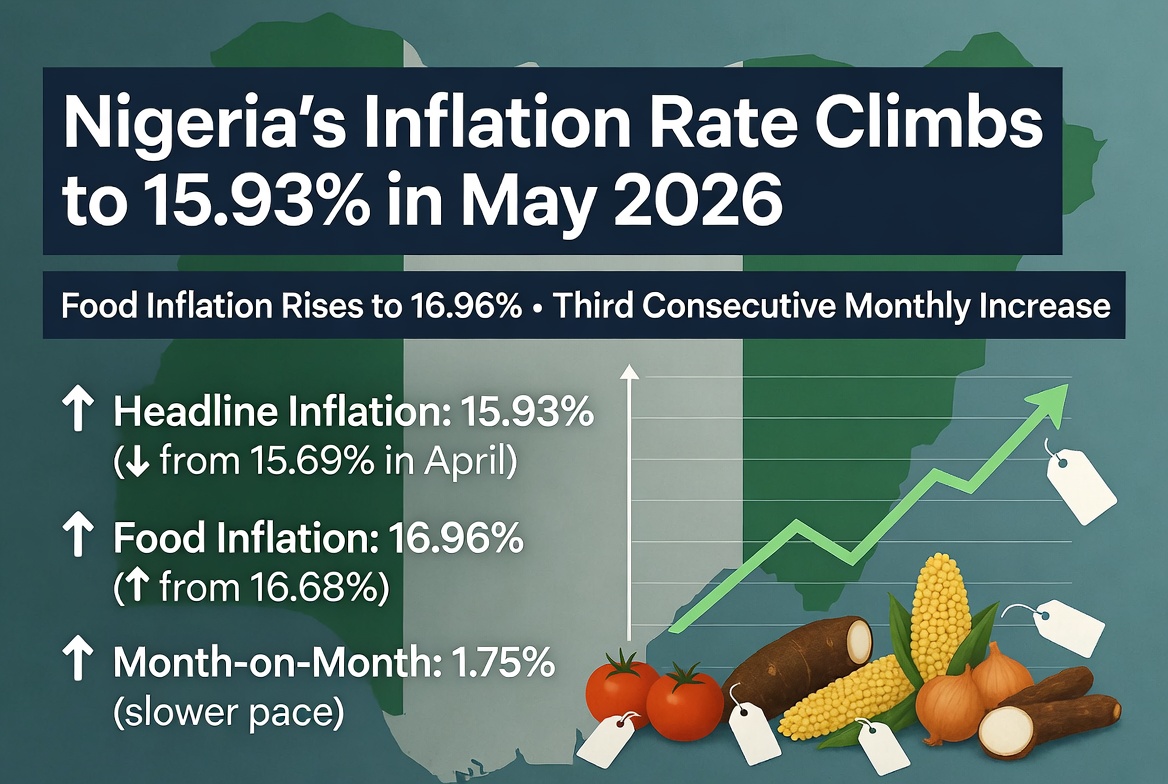
Nigeria’s headline inflation rate rose to 15.93 per cent in May 2026, marking the third consecutive monthly increase this year, according to the latest Consumer Price Index (CPI) report released by the National Bureau of Statistics (NBS).
The new figure represents an increase from the 15.69 per cent recorded in April 2026, reflecting continued upward pressure on consumer prices across the country.
Despite the rise, the inflation rate remained significantly lower than the 26.06 per cent recorded in May 2025, indicating a substantial moderation compared to the same period last year.
According to the NBS, the year-on-year headline inflation rate increased by 0.24 percentage points when compared to April.
“On a year-on-year basis, the Headline inflation rate rose to 15.93%, up from 15.69% in April 2026 and down from 26.06% in the same month of the preceding year (May 2025),” the bureau stated.
However, on a month-on-month basis, inflation eased slightly. The NBS reported that headline inflation stood at 1.75 per cent in May, lower than the 2.13 per cent recorded in April.
The bureau explained that this suggests the pace at which average prices increased in May was slower than in the previous month.
Food Inflation Rises to 16.96%
Food inflation, a key component affecting household spending, also increased during the period.
The NBS said the food inflation rate stood at 16.96 per cent year-on-year in May, compared to 16.68 per cent recorded in April.
Although food prices remained elevated, the figure was considerably lower than the 24.55 per cent recorded in May 2025.
On a month-on-month basis, food inflation slowed to 2.98 per cent from 3.63 per cent in April, representing a decline of 0.65 percentage points.
The bureau attributed movements in food prices to changes in the cost of products such as fresh onions, maize, melon (egusi), water yam, cassava flour, crayfish, fresh pepper, tomatoes, wheat grain, cassava tuber, yam tuber, sweet potatoes, ginger, plantain and cowpea.
State-by-state analysis showed that food inflation was highest on a year-on-year basis in Adamawa at 29.62 per cent, followed by Kwara at 28.47 per cent and Rivers at 28.40 per cent.
The slowest increases were recorded in Borno at minus 6.53 per cent, Taraba at 1.13 per cent and Bayelsa at 5.99 per cent.
On a month-on-month basis, Bauchi recorded the highest food inflation rate at 7.73 per cent, followed by Ogun at 6.86 per cent and Jigawa at 6.69 per cent.
Meanwhile, Niger at 3.54 per cent, Katsina at minus 3.48 per cent and Gombe at minus 2.22 per cent recorded the slowest monthly increases in food prices.
The latest figures underscore the persistent challenge of inflation despite signs that the pace of price increases may be moderating.
Written by
Our Reporter
SkyHigh NewsHub correspondent.