
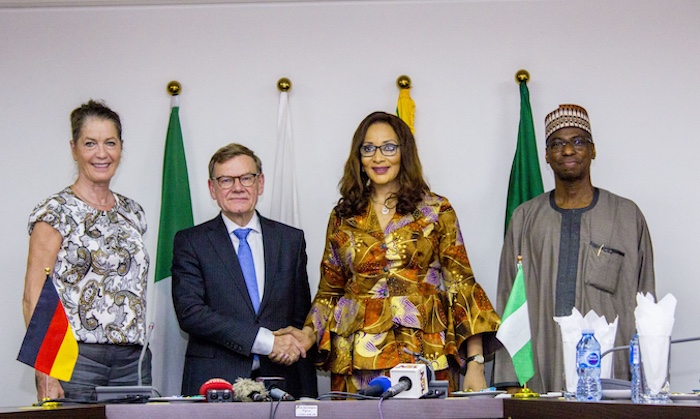
Nigeria, Germany Deepen Energy, Security, Technology Partnership as Foreign Ministers Meet
By OUR REPORTER · 23/07/2026 7:53 AM · 4 min read
Nigeria and Germany have reaffirmed their commitment to expanding bilateral relations, with both countries agreeing to deepen cooperation in renewable energy, technology, manufacturing, security, trade and human capital development as they seek to unlock new opportunities for economic growth and regional stability.
The renewed commitment was made on Wednesday during a bilateral meeting in Abuja between Nigeria's Minister of Foreign Affairs, Ambassador Bianca Odumegwu-Ojukwu and Germany's Federal Minister for Foreign Affairs, Johann Wadephul, who is on an official visit to Nigeria.
The meeting comes as both countries move to strengthen an already expanding partnership. Earlier this week, Wadephul led a high-powered German business delegation to Lagos, where German officials and business executives identified Nigeria as one of Africa's most promising investment destinations. During that visit, the German foreign minister disclosed that Nigeria had become one of Europe's leading suppliers of jet fuel, underscoring the country's growing strategic importance to Europe.
Welcoming the German delegation, Odumegwu-Ojukwu described Germany as one of Nigeria's most important strategic partners in Europe, noting that decades of cooperation had been built on mutual trust, respect and shared interests.
She said the relationship had evolved beyond traditional diplomatic engagement to encompass trade and investment, development cooperation, renewable energy, education, vocational training, science and technology, migration, culture, peace and security.
"Germany has remained one of Nigeria's most important strategic partners in Europe. Our bilateral relations extend beyond diplomacy to encompass trade and investment, development cooperation, renewable energy, education, vocational training, science and technology, migration, culture, peace and security," she said.
According to the minister, the partnership has become increasingly significant at a time when countries are confronting complex global challenges, including terrorism, violent extremism, climate change, irregular migration, food insecurity, geopolitical tensions and economic uncertainty.
She reaffirmed Nigeria's commitment to strengthening cooperation with Germany in ways that deliver tangible benefits for citizens of both countries while contributing to regional and international stability.
Odumegwu-Ojukwu identified renewable energy, artificial intelligence, critical minerals, manufacturing, agriculture, healthcare, infrastructure and the green economy as sectors offering enormous opportunities for expanded collaboration.
She also highlighted the Nigeria-Germany Bi-National Commission as a major platform for advancing bilateral relations, recalling that its 2025 session reinforced commitments to deepen cooperation across priority sectors.
According to her, the Federal Government has continued implementing agreements reached during the commission, including reforms designed to improve Nigeria's investment climate, strengthen governance and encourage greater private-sector participation in the economy.
The minister further commended Germany for its longstanding support for the Economic Community of West African States (ECOWAS), particularly in promoting regional integration, democratic governance, conflict prevention, peacebuilding and humanitarian assistance.
She stressed that continued international collaboration remains critical in addressing insecurity across West Africa, including terrorism, violent extremism, unconstitutional changes of government and transnational organised crime.
On economic cooperation, Odumegwu-Ojukwu said President Bola Ahmed Tinubu's administration has placed economic diplomacy at the centre of Nigeria's foreign policy, with a strong emphasis on attracting foreign investment and expanding international partnerships.
She therefore called for increased German investment in key sectors of the Nigerian economy, including renewable energy, manufacturing, transport infrastructure, critical minerals, agriculture, digital technology and industrial development.
The Abuja talks build on growing momentum in Nigeria-Germany relations. During his engagements with business leaders in Lagos, Wadephul reaffirmed Germany's commitment to strengthening economic ties with Nigeria, describing the country as one of Berlin's most important partners on the African continent.
He noted that Nigeria's role in Europe's energy supply had become increasingly significant, revealing that in the first half of 2026, Nigeria emerged as one of Europe's leading suppliers of jet fuel, accounting for about 25 per cent of the continent's imports in June alone.
The German foreign minister also said Berlin was committed to expanding cooperation in renewable energy, infrastructure, education, technology and security, while encouraging more German companies to invest in Nigeria.
German business executives accompanying the delegation echoed that position, identifying Nigeria's fast-growing digital economy, improving investment climate and ongoing power sector reforms as key attractions for long-term investment.
The discussions in Abuja are expected to further consolidate the growing partnership between both countries as they pursue closer cooperation in energy transition, trade, innovation, industrialisation and regional security.
Written by
Our Reporter
SkyHigh NewsHub correspondent.