
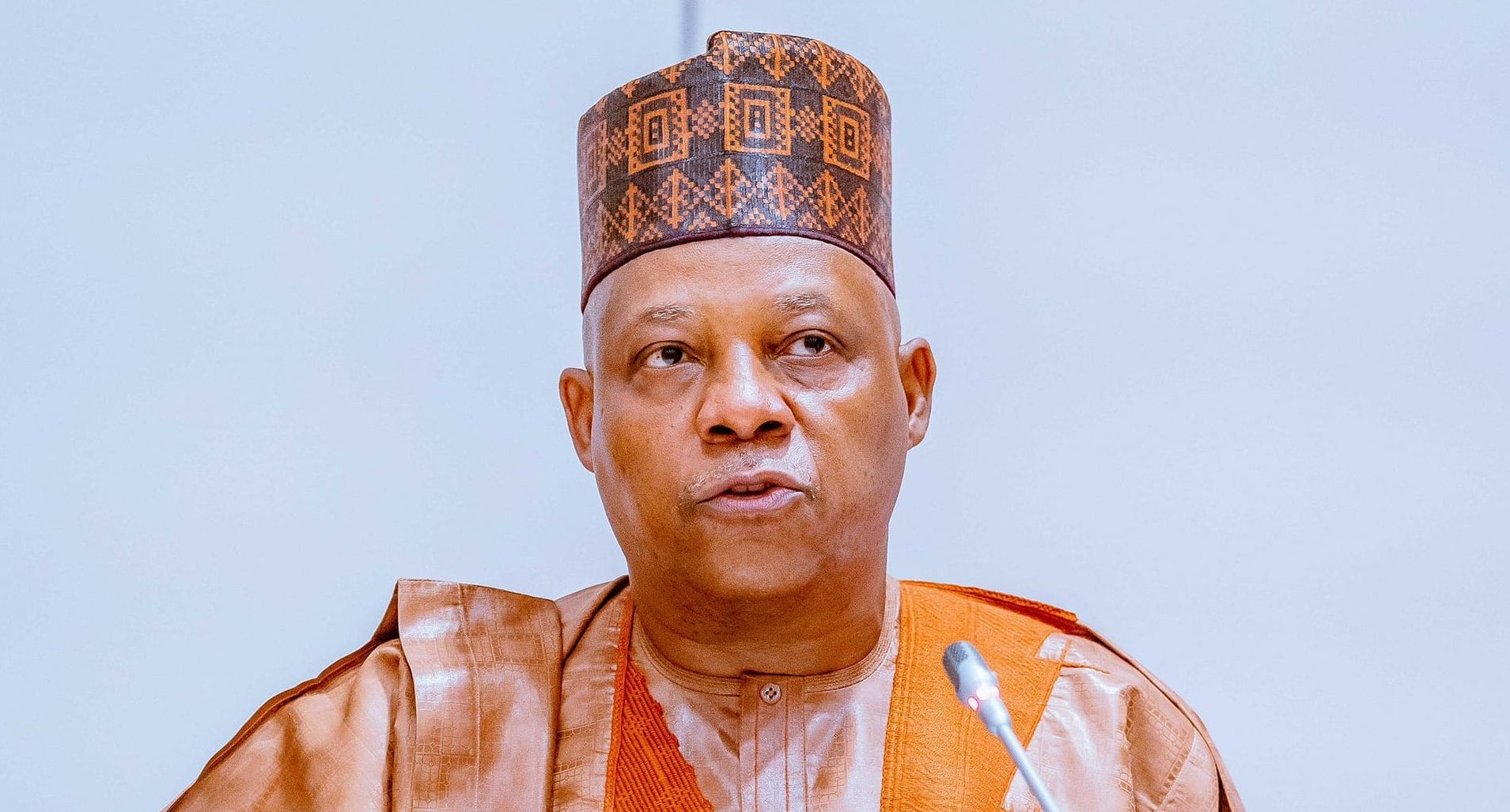
Nigeria Can’t Achieve $1tn Economy on Weak Governance, Shettima Warns
By OUR REPORTER · 22/07/2026 7:14 AM · 4 min read
Vice President Kashim Shettima has warned that Nigeria’s ambition to build a $1 trillion economy cannot be achieved without stronger corporate governance, regulatory compliance and institutional accountability.
Shettima said the country’s economic transformation agenda would remain vulnerable if businesses and public institutions continued to operate amid regulatory weaknesses, poor compliance and ethical lapses.
The Vice President spoke on Monday at the 3rd National Corporate Governance Summit organised by the Institute of Directors Centre for Corporate Governance (IoDCCG) in Lagos.
The summit, held in collaboration with the Financial Reporting Council (FRC), Ministry of Finance Incorporated (MOFI) and the Institute of Chartered Secretaries and Administrators of Nigeria (ICSAN), had the theme, “Implementing Good Governance for Economic Acceleration, Consolidating Public-Private Partnership.”
Represented by the Special Adviser to President Bola Ahmed Tinubu on Economic Affairs, Tope Fasua, Shettima said the theme was closely aligned with the administration's Renewed Hope Agenda and its ambition to create a more resilient and competitive Nigerian economy.
He noted that the Federal Government's reforms, including the removal of fuel subsidy, harmonisation of the foreign exchange market and restructuring of strategic sectors, were designed to establish a stronger macroeconomic foundation for investment and growth.
However, he said the private sector must play a central role in converting those reforms into productive investments, sustainable employment and increased national wealth.
“Under this administration, our focus is on building a resilient, competitive and $1 trillion economy, driven by enterprise, systematic investments and comprehensive institutional reforms.
“However, we must confront an undeniable truth. The lofty mountain of a $1 trillion economy cannot be scaled on the shaky terrain of weak compliance; it requires a bedrock of flawless governance,” he said.
Shettima said Nigeria already had a substantial framework for corporate governance, including the Nigeria Code of Corporate Governance, the Companies and Allied Matters Act and sector-specific regulations issued by institutions such as the Central Bank of Nigeria, the National Insurance Commission and the Securities and Exchange Commission.
He, however, lamented that the country had continued to witness major corporate failures arising from insider abuse, creative accounting, weak oversight and reckless risk-taking.
According to him, Nigeria's challenge has often been less about the absence of policies and frameworks and more about the failure to consistently implement and enforce them.
The Vice President said the Federal Government was also working to strengthen governance within state-owned enterprises through MOFI, while pursuing reforms in public procurement and digitising government processes.
He said such measures were necessary to improve transparency, efficiency and accountability across the public sector while creating a more attractive environment for private investment.
Also speaking, the Managing Director and Chief Executive Officer of MOFI, Dr Armstrong Takang, said effective corporate governance and well-managed state-owned enterprises would be critical to Nigeria's pursuit of a $1 trillion economy.
Takang challenged the argument that government should have no role in business, pointing to China's experience, where state-owned enterprises play significant roles in infrastructure, technology and manufacturing.
He cited the scale of assets managed by Chinese government-owned enterprises as evidence that state participation, when supported by strong governance and professional management, could contribute significantly to economic development.
The President and Chairman of the Governing Council of ICSAN, Mrs Uto Ukpana, said good governance should be regarded as a strategic necessity rather than merely an administrative requirement.
Ukpana argued that Nigeria did not lack policies and economic plans but needed stronger leadership commitment, ethical conduct, effective oversight, regulatory consistency and a culture of accountability to translate policies into measurable results.
She said sustainable economic growth would depend on the ability of public and private institutions to build systems that encourage responsible decision-making and protect the interests of investors and citizens.
In his remarks, the Chairman of the Board of Governors of the IoD Centre for Corporate Governance, Mr Urum Kalu Eke, said effective corporate governance was essential to strengthening institutions and boosting investor confidence.
“When corporate governance is entrenched, institutions become stronger, accountability becomes the norm, investors confidence grows, and the economy is better positioned to achieve sustainable growth and long-term national development,” Eke said.
The summit highlighted the growing role of corporate governance in Nigeria's economic transformation agenda, with stakeholders stressing that the country's $1 trillion economic ambition would require more than macroeconomic reforms.
They argued that stronger institutions, transparent regulation, ethical business practices and effective public-private collaboration would be critical to sustaining investment, improving productivity and ensuring that economic growth translates into broader national development.
Written by
Our Reporter
SkyHigh NewsHub correspondent.