Germany Eyes Bigger Investments as It Hails Nigeria's Rising Role in Europe’s Energy Supply
By OUR REPORTER · 23/07/2026 7:48 AM · 5 min read
Germany has signalled plans to deepen economic cooperation with Nigeria, with senior government officials and business executives describing Africa's largest economy as a strategic investment destination with growing opportunities in energy, technology, infrastructure and digital innovation.
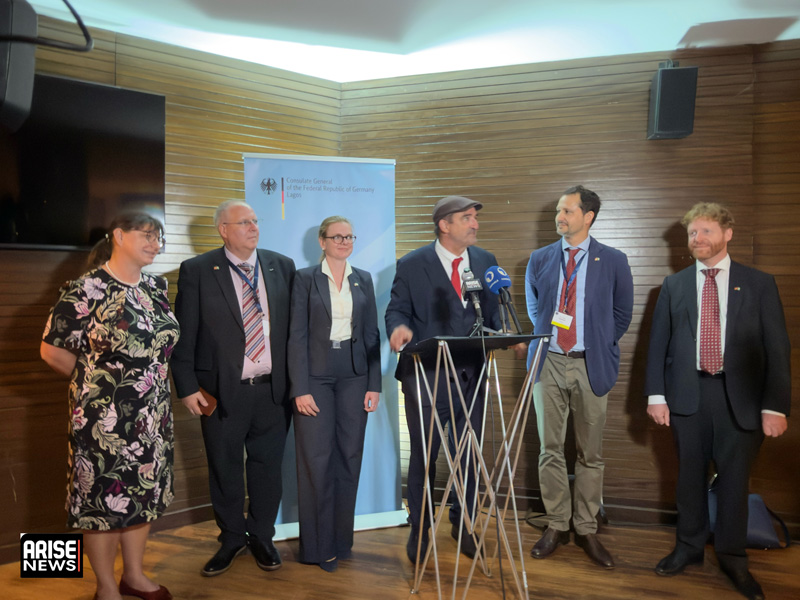
The renewed commitment was made during a networking reception hosted by Germany's Consul General in Lagos, Daniel Krull, to mark the official visit of German Foreign Minister Johann Wadephul to Nigeria. The event brought together senior Nigerian officials, executives of German companies and a high-level business delegation exploring investment opportunities in the country.
Speaking at the event, Wadephul described Nigeria as an increasingly important partner for Germany and Europe, particularly in the energy sector, revealing that Nigeria has emerged as one of Europe's leading suppliers of jet fuel.
"In the first half of 2026, Nigeria has become one of the most important jet fuel suppliers for Europe," the German foreign minister said.
"Only in June, Nigeria covered 25 per cent of Europe's jet fuel supplies. This is a vivid testimony of the importance of our partnership bilaterally and on global world trade."
He said Germany intends to build on its longstanding relationship with Nigeria by expanding cooperation in trade, investment, energy, education and security.
"We want to work together, Germany and Nigeria, Europe and Africa, striving for security, freedom and prosperity for our nations," Wadephul said.
According to him, trade and investment remain central pillars of bilateral relations, explaining that his visit with a delegation of German companies reflects Berlin's commitment to strengthening commercial ties with Nigeria.
He added that German industry is prepared to support Nigeria's energy transition while helping unlock the country's vast gas and oil potential alongside renewable energy development.
"German industry stands ready to support Nigeria in reducing its carbon footprint by unlocking this enormous potential using gas and oil," he said.
Wadephul also highlighted Nigeria's contributions to regional security, noting that Germany has provided military instructors, equipment and about 120 million dollars in support for security cooperation in the Gulf of Guinea and the Lake Chad Basin.
Beyond security and energy, he said cooperation between both countries has expanded into education, research and cultural exchange, revealing that more than 50 university partnerships now exist between German and Nigerian institutions, while the number of Nigerian students studying in Germany has quadrupled over the past decade.
He also pointed to Nigeria's fast-growing technology ecosystem as an area with enormous potential for collaboration.
"I believe there is a tremendous potential for expanding our partnership when Europe's largest economy and Africa's most populous nation and economic powerhouse come together. Good things can happen, provided we stand together and work together," he said.
Speaking on behalf of the German business delegation, Christoph Wolfrum, Director General for EU Policy and Geoeconomics at Germany's Foreign Ministry, said Nigeria's economic prospects were a key reason for the large delegation accompanying the minister.
"We've come here with a rather large business delegation because we believe that Nigeria is a country full of potential for our bilateral economic relationship," Wolfrum said.
"The country is thriving. There's a lot of growth. There are many positive developments across different sectors, and there is already a solid foundation on which we can build, particularly in the field of energy."
He noted that Germany and Nigeria already share a longstanding energy partnership covering conventional energy, renewable energy and climate protection, while identifying information technology as another sector with significant opportunities.
"We have a lot of sectors where we see huge potential. In the IT sector, a lot of things are happening here in Nigeria, and German companies and Nigerian companies have a great field of cooperation," he added.
President of the German-African Business Association and Chief Executive Officer of Siemens Sub-Saharan Africa, Sabine Dall'Omo, said German companies are increasingly optimistic about Nigeria's investment climate, especially in digitalisation, cybersecurity and electricity infrastructure.
She described the Presidential Power Initiative between Nigeria and Germany as one of the flagship projects demonstrating the growing partnership.
According to her, Siemens is implementing the project alongside Nigerian partners as part of efforts to strengthen local capacity and technology transfer.
"We have decided that it has to be done by Nigerians, particularly partners which we have signed up with, to support competence development here in the country," Dall'Omo said.
"We are working closely with these partners to improve the availability of skills and technology in the Nigerian market."
She also welcomed Nigeria's recent removal from the Financial Action Task Force (FATF) grey list, describing the development as a significant boost to investor confidence.
"One of the great achievements, and congratulations to the industry and financial sector here in Nigeria is the removal from the FATF grey list, which creates higher levels of trust in the Nigerian economy," she said.
According to Dall'Omo, improved confidence in Nigeria's financial system could gradually lower financing costs and encourage additional foreign investment.
Also speaking, Dr Tobias Engelmeier, Chief Executive Officer and Co-Founder of Village Data Analytics (VIDA), said his company has worked in Nigeria over the past three years to improve electricity access using data-driven infrastructure planning.
"We have been working in Nigeria for the past three years on bringing electricity access to more Nigerians quickly, and that has been a very fruitful collaboration, thanks largely to the dynamic business environment in Nigeria," he said.
Engelmeier said his company hopes to expand its operations while strengthening cooperation with Nigerian authorities.
He added that artificial intelligence could transform infrastructure development by improving data analysis, predictive planning and project monitoring.
"Broadly speaking, infrastructure investment has historically suffered from a lack of data. With AI, we can accelerate infrastructure development and make the entire process much more sustainable," he said.
The reception concluded with discussions between German investors, Nigerian government officials and business leaders on expanding cooperation across energy, infrastructure, technology, education and trade, underscoring growing confidence in Nigeria's long-term economic potential.
Written by
Our Reporter
SkyHigh NewsHub correspondent.