
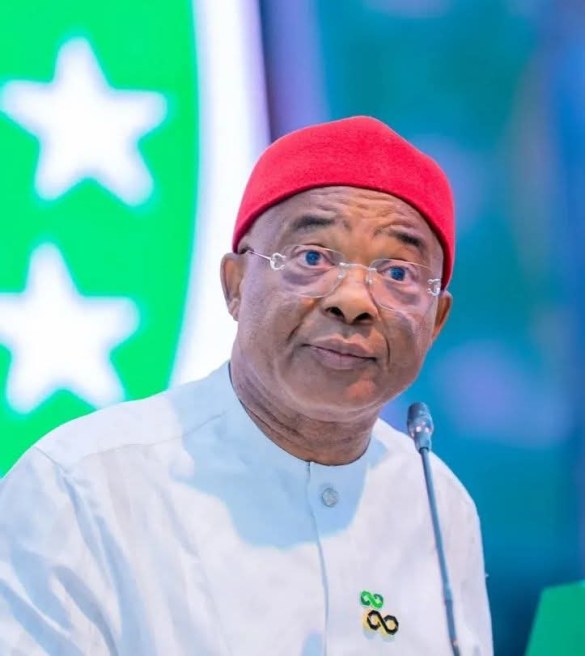
2027: South-East Governors Will Back Tinubu’s Re-election, Says Uzodimma
By OUR REPORTER · 22/07/2026 5:36 PM · 4 min read
Imo State Governor and Chairman of the South-East Governors’ Forum, Senator Hope Uzodimma, has disclosed that the five governors of the South-East have resolved to support President Bola Ahmed Tinubu’s re-election bid in the 2027 presidential election, citing what he described as the administration’s unprecedented commitment to the development of the region through major infrastructure and economic initiatives.
Uzodimma made the disclosure during a meeting with members of the Imo State Elders Council and traditional rulers in Owerri, where he said the governors had carefully assessed the impact of the Tinubu administration on the South-East and unanimously agreed that continued collaboration with the Federal Government was in the region’s best interest.
According to him, the decision was reached after reviewing the President’s performance and the level of federal intervention across the South-East, which he said had addressed several longstanding developmental concerns.
“We, the five governors of the South-East, have reviewed all options and decided that we will work with President Bola Tinubu because we want to be part of the Project Nigeria,” Uzodimma said.
The governor added that the governors would soon pay a joint courtesy visit to President Tinubu to further consolidate their relationship with the Federal Government and strengthen collaboration on developmental initiatives affecting the region.
Uzodimma said one of the administration’s most significant achievements for the South-East was the establishment of the South East Development Commission (SEDC), describing it as the fulfilment of a demand that had remained unresolved since the end of the Nigerian Civil War.
He recalled that President Tinubu signed the South East Development Commission Act into law on July 24, 2024, inaugurated the commission’s governing board in February 2025 and subsequently provided funding to enable the commission commence operations.
According to the governor, the establishment of the commission marked a historic milestone in addressing developmental challenges unique to the South-East.
He also highlighted the rehabilitation and commencement of commercial operations on the Port Harcourt–Aba rail line, describing the project as the first practical step toward reconnecting the South-East to Nigeria’s national railway network.
Uzodimma further commended the Federal Government for approving the 3 billion-dollar reconstruction of the Eastern Rail Corridor, stretching from Port Harcourt through the South-East to Maiduguri, noting that the project would significantly enhance trade, transportation and regional economic integration.
The governor also pointed to several ongoing federal road projects within the region as evidence of the administration’s commitment to infrastructure development.
Among the projects he listed were the Phase 2A and Phase 2B access roads to the Second Niger Bridge, including the dual carriageway linking Umunya, Ogbunike, Ogidi, Nkpor and Asaba, with seven bridges along the corridor.
He further referenced the approval of the 108-kilometre Otuocha–Anam–Abaji Road and the 150-kilometre Oba–Nnewi–Uga–Ihube/Okigwe Junction Road, projects he said would strengthen economic connectivity between Anambra, Imo, Abia and other parts of the country.
Beyond infrastructure, Uzodimma said the South-East had also benefited from broader national policies introduced by the Tinubu administration, including increased allocations to state governments, the student loan programme, improved security efforts and fiscal reforms designed to stimulate economic growth and reduce the cost of doing business.
“The South-East has decided. Our people judge governments by performance and not by political sentiments. The evidence is on the ground,” he stated.
Shifting attention to Imo State, the governor appealed to members of the Imo State Elders Council and traditional rulers to remain committed to the implementation of the state’s Charter of Equity, describing it as the foundation for enduring peace, fairness and political stability.
He recalled that upon assuming office in 2020, his administration inherited a politically divided state and subsequently introduced reforms aimed at rebuilding public trust, promoting inclusiveness and fostering unity.
According to him, the Charter of Equity, which has since been enacted into law by the Imo State House of Assembly, was designed to institutionalise fairness in the rotation of political power among the state’s geopolitical zones.
“The Charter of Equity is real, and I need your mandate to implement it because that is what will bring lasting peace to Imo State,” he said.
Uzodimma maintained that whoever succeeds him as governor must emerge in line with the Charter of Equity and possess the integrity, competence and commitment required to sustain the progress achieved under his administration.
He said the next governor should be God-fearing, fair-minded and dedicated to preserving the principles of equity, justice and good governance rather than reversing the gains already made.
The governor warned against attempts to undermine the Charter of Equity for personal political interests, declaring that he would defend the law to ensure the long-term political stability of the state.
“I will take the fight personally to protect the Charter of Equity. I will stop at nothing,” he declared.
Uzodimma also advocated increased investment in skills acquisition and vocational education, describing youth empowerment as one of the most sustainable strategies for reducing unemployment, curbing crime and driving long-term economic development.
He urged traditional rulers to continue partnering with government in promoting peace, supporting development initiatives and preserving the stability required for inclusive growth across Imo State.
Written by
Our Reporter
SkyHigh NewsHub correspondent.