
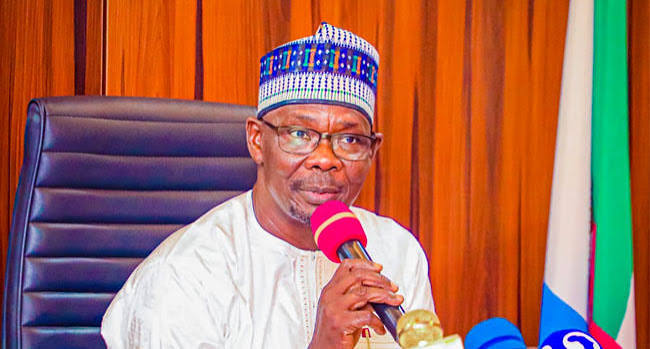
Muslim-Muslim Tickets Have Won, Christian-Christian Will Win Too, Says Sule
By OUR REPORTER · 22/07/2026 10:31 AM · 3 min read
Nasarawa State Governor, Abdullahi Sule, has said Nigeria will one day elect a presidential ticket comprising two Christians, arguing that the country's Constitution does not require religious balancing in political appointments or electoral contests.
Sule made the remarks on Tuesday during an appearance on Channels Television's Politics Today, where he also defended the constitutional basis for inclusiveness and representation in Nigeria's political system.
The governor's comments came in response to criticism from Rabiu Kwankwaso, the 2027 vice-presidential candidate of the Nigeria Democratic Congress (NDC), over issues surrounding representation and political appointments.
Sule dismissed Kwankwaso's position as part of the normal rhetoric of opposition politics, while stressing that he respected the former Kano State governor.
“I think it is normal for Senator Kwankwaso, whom I respect a lot, to say that because he’s opposition. He cannot say anything good. It is expected of him to say that,” Sule said.
The Nasarawa governor argued that references to constitutional provisions on inclusiveness and representation were sometimes interpreted to include religious balancing, whereas, in his view, the relevant sections of the 1999 Constitution focus on broader principles of federal character, inclusiveness and equitable representation.
He specifically cited Sections 14(3) and 15 of the Constitution, arguing that neither provision expressly requires religious balancing in political appointments or electoral tickets.
“There is no place where it talks about religion. Section 14 didn’t talk about religion. Section 15 did not talk about religion,” Sule said.
Sule pointed to Nigeria's political history as evidence that religiously similar presidential tickets have previously won elections.
He referenced the Muslim-Muslim ticket of President Bola Tinubu and Vice-President Kashim Shettima, as well as the presidential ticket of the late MKO Abiola and Babagana Kingibe in the 1993 election.
Against that background, the governor said he hoped Nigeria would eventually elect a presidential ticket made up of two Christians.
“You can see both elections have been clear that the Muslim-Muslim ticket has won. I pray that one day Nigeria will have a Christian-Christian ticket, and it will win,” he said.
Sule's comments come amid continuing national debate over the role of religion in Nigerian politics, particularly following the 2023 presidential election, which was contested by several major parties on different religious and regional platforms.
The Tinubu-Shettima ticket, both Muslims, generated significant debate before and during the 2023 election, with critics arguing that the ticket did not adequately reflect Nigeria's religious diversity.
Supporters, however, maintained that competence and political representation should take precedence over religious considerations.
The Nasarawa governor also addressed his decision to have a Christian as his deputy, saying the choice was based primarily on competence and the political realities of the state rather than a constitutional requirement for religious balancing.
He said his deputy, Emmanuel Akabe, is a Christian and that Nasarawa's political circumstances differ from those of Nigeria as a whole.
“I have always had a Christian as a deputy, Emmanuel Akabe. In Nasarawa State, it has always been a Christian. We thought it was important because Emmanuel Akabe is competent and our state is different from Nigeria,” Sule said.
He argued that political arrangements at the state level should not necessarily be used as a template for the federal government because Nigeria's states have different religious, ethnic and political dynamics.
Sule cited states such as Enugu and Bayelsa, where he said Christian-Christian political arrangements are common.
“Take Enugu, for instance, they are Christian-Christian. Take Bayelsa; it’s Christian-Christian,” he added.
The governor's position effectively separates the question of religious balance from that of political representation, arguing that while Nigeria's diverse population requires inclusive governance, the Constitution does not prescribe a specific religious formula for presidential or other political tickets.
His remarks are likely to fuel further debate as political parties and presidential hopefuls begin positioning themselves ahead of the 2027 general election, where questions of religion, regional balance, competence and political alliances are expected to remain significant issues in the contest for power.
Written by
Our Reporter
SkyHigh NewsHub correspondent.