
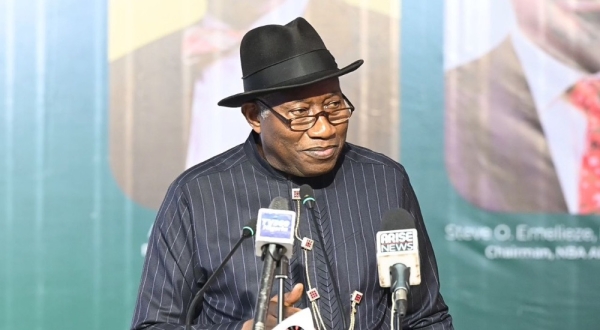
2027: Democracy in Danger if Nigerians Lose Faith in Elections — Jonathan
By OZIOMA IWUH · 21/05/2026 11:40 AM · 4 min read
Former President Goodluck Jonathan has warned that Nigeria’s democracy could face a deeper legitimacy crisis if courts continue determining electoral winners instead of the electorate.
Jonathan made the remarks on Wednesday while speaking at the opening ceremony of the Nigerian Bar Association (NBA) Abuja Law Week 2026 held at the NBA House in Abuja. The event was themed, “Safeguarding Nigeria’s Democratic Process.”
The former president, who attended as Special Guest of Honour, stressed that electoral integrity, judicial independence and institutional reforms remain critical to protecting Nigeria’s democracy ahead of the 2027 general elections. According to him, the growing number of election-related court cases after every poll has become both abnormal and dangerous for democratic stability. “At the end of every round of elections, the number of cases that go to court is overwhelming,” Jonathan said.
“Some of the people go to court, even their family members don’t vote for them. But they go to court simply because we believe that the judiciary could be manipulated to declare people who ordinarily are not supposed to win elections as winners.”
Jonathan recalled a conversation with a former South African deputy president who expressed surprise over Nigeria’s culture of post-election litigation. “She asked me, ‘Why would somebody go to court after losing an election?’ In South Africa, going to court after losing an election is strange. But in Nigeria, not going to court is strange,” he stated.
The former president argued that courts should not directly declare winners in disputed elections. Instead, he said fresh elections should be ordered where substantial irregularities are established. “The judiciary should do its work, but if they are not satisfied with the process, they should send the parties back to the field. Let the ballot decide who wins,” he said.
Jonathan also questioned the structure of Nigeria’s electoral litigation system, describing it as inconsistent and cumbersome. “Governorship election petitions go through tribunal, Appeal Court and Supreme Court, while presidential elections go through fewer stages. Are you saying electing a governor is more important than electing a president?” he queried.
The former president lamented Nigeria’s low voter turnout, describing it as the worst in Africa despite the country’s population advantage. “Nigeria has the least voter turnout in Africa. INEC needs to investigate why this is happening. It cannot simply be explained by voter apathy alone,” he said.
Jonathan blamed electoral violence and political thuggery for weakening public confidence in elections, warning that Nigeria had normalized a dangerous culture where political thugs now wield enormous influence. “Nigeria is the only country where thuggery is becoming a profession,” he said.
“Some thugs travel first class while university professors struggle to buy economy tickets. That country is like a canoe turned upside down.”
He stressed that democracy cannot survive merely through periodic elections but through credible institutions, accountability, rule of law and transparent electoral processes.
“The INEC must remain independent not only in name but in practice. Once citizens lose confidence in elections, democracy itself becomes endangered,” Jonathan warned.
He also cautioned the judiciary against becoming an instrument for political manipulation.
“The courts must never become tools for partisan interests. Justice must not only be done, it must be seen to be done fairly and courageously,” he added.
Jonathan further urged the NBA to collaborate with the National Assembly in reviewing Nigeria’s electoral and judicial laws, including the possibility of establishing a Constitutional Court to exclusively handle electoral disputes.
Former Attorney-General of the Federation, Mohammed Adoke, also warned at the event that Nigeria’s democracy was standing at a “precarious crossroads.”
According to Adoke, democracy should not merely be measured by the conduct of elections, but by the public’s confidence in electoral outcomes.
“The real question is not whether Nigeria is democratic. It is whether we are safeguarding democracy or merely managing appearances,” he stated.
NBA President Afam Osigwe also expressed concern over the growing judicialisation of politics, warning that Nigerians increasingly fear courts now play a dominant role in deciding who governs.
He called for stronger democratic institutions and credible elections ahead of 2027.
Written by
Ozioma Iwuh
SkyHigh NewsHub correspondent.