
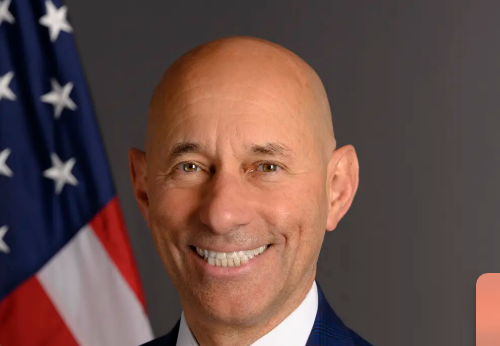
Top US Diplomat’s Nigeria Visit Signals Trump’s New West Africa Strategy
By OUR REPORTER · 14/07/2026 6:42 PM · 4 min read
Nigeria is set to host the United States Assistant Secretary of State for African Affairs, Frank Garcia, in what will be his first official visit to Africa since assuming office, a trip analysts say reflects the Trump administration's emerging foreign policy priorities for West Africa.
Garcia's itinerary includes Nigeria, Côte d'Ivoire and Mali, a selection widely viewed as a deliberate effort by Washington to strengthen strategic partnerships built around security cooperation, economic engagement and national sovereignty rather than traditional development assistance.
According to geopolitical analyst Pearl Matibe, the visit signals a shift in the United States' engagement with Africa under President Donald Trump, moving away from broad diplomatic rhetoric toward relationships driven by mutual interests and measurable outcomes.
Among the three countries on Garcia's itinerary, Nigeria occupies the most significant position.
As Africa's largest economy and one of the continent's most influential security actors, Nigeria remains central to American interests in counterterrorism, regional stability, energy security and commercial investment.
Observers say Garcia's visit to Abuja should be interpreted as more than routine diplomacy.
Instead, it demonstrates Washington's recognition that Nigeria's political and economic decisions have far-reaching implications for the Gulf of Guinea, the wider West African region and neighbouring Sahel states.
Earlier this year, Garcia told the US Senate Foreign Relations Committee that, if confirmed, he would pursue an "America First" approach to Africa by promoting disciplined and strategic engagement rooted firmly in American national interests.
He also stressed that future partnerships should be "mutually beneficial" while respecting the sovereign choices of African nations.
That position, analysts argue, represents an attempt by Washington to redefine its relationship with African governments not by withdrawing from the continent, but by focusing on practical cooperation that serves the interests of both parties.
Garcia's visit to Côte d'Ivoire reflects another aspect of the Trump administration's regional strategy.
Abidjan has emerged as one of Washington's strongest partners in West Africa due to its relative political stability, expanding economy and growing role in regional security.
Relations between both countries have strengthened considerably since President Donald Trump sent a presidential delegation to President Alassane Ouattara's inauguration in December 2025.
Since then, cooperation has expanded across infrastructure, healthcare, defence and private-sector investment.
American drone logistics company Zipline has become involved in strengthening Côte d'Ivoire's healthcare delivery system, while infrastructure partnerships and military cooperation have also deepened.
The country recently entered a State Partnership Programme with the Pennsylvania National Guard and continues to participate in multinational security exercises such as Exercise Flintlock.
Analysts describe Côte d'Ivoire as an example of how African countries can maintain productive partnerships with multiple global powers while preserving policy independence.
Mali represents perhaps the most complex leg of Garcia's planned visit.
The country has increasingly distanced itself from Western security partnerships following military takeovers and has strengthened ties with Russia's Africa Corps while aligning more closely with fellow members of the Alliance of Sahel States.
Despite those developments, the United States has maintained diplomatic engagement with Bamako and appears keen to preserve channels of communication.
Earlier this month, Garcia and US Deputy Secretary of State Christopher Landau met diplomats representing Mali, Burkina Faso and Niger in Washington to discuss bilateral cooperation and regional security.
Analysts believe the planned visit to Mali will test whether Washington can deepen cooperation on counterterrorism and regional stability while respecting the country's stated commitment to sovereignty.
The broader implication of Garcia's visit extends beyond the three countries on his itinerary.
West Africa has become an increasingly competitive geopolitical arena, with the United States, China, Russia, France, Turkey and several other powers seeking to expand their influence across the region.
Against that backdrop, Nigeria is expected to play a pivotal role in shaping future diplomatic, security and economic cooperation.
Analysts say Garcia's inaugural African tour will provide an early indication of whether the Trump administration can build partnerships that are both strategically beneficial and respectful of the priorities of African governments.
For Nigeria, the visit reinforces its position as a key regional partner whose importance to Washington continues to grow amid shifting global political and economic dynamics.
Written by
Our Reporter
SkyHigh NewsHub correspondent.