
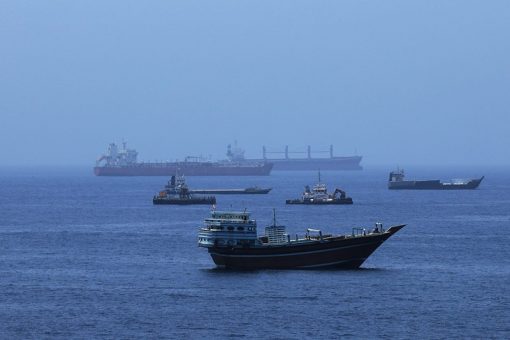
Oil Prices Jump as Fresh US-Iran Tensions Threaten Strait of Hormuz
By OUR REPORTER · 13/07/2026 6:32 AM · 3 min read
Global oil prices rose sharply at the start of the week after renewed military tensions between the United States and Iran heightened concerns over crude oil supplies through the Strait of Hormuz, one of the world's most critical energy shipping routes.
Brent crude opened at $76.01 per barrel, while West Texas Intermediate (WTI) traded at $71.41 per barrel, as traders reacted to fears that continued hostilities could further disrupt global energy supplies.
The latest escalation has significantly slowed shipping traffic through the Strait of Hormuz, with market participants increasingly worried that even limited disruptions could have widespread consequences for global fuel markets.
Before the conflict began on February 28, the Strait of Hormuz handled roughly 20 per cent of the world's daily oil and natural gas supplies, making it one of the most strategically important waterways for global energy trade.
Brent crude was on course to record a weekly gain of about 5.5 per cent following attacks on commercial tankers, retaliatory military strikes between Washington and Tehran, and the United States' decision to revoke a general licence permitting the sale of Iranian oil.
The latest spike came after Iran's Islamic Revolutionary Guard Corps (IRGC) announced the closure of the Strait of Hormuz, claiming it had fired warning shots at a vessel attempting to navigate what it described as an unauthorised route through the waterway.
In a statement carried by the IRGC-affiliated Tasnim News Agency, the force accused foreign powers of interfering in the region and declared that the Strait would remain closed until further notice unless what it called US interference ceased.
"The Strait of Hormuz is to be closed until further notice... No vessel or naval craft will be allowed to pass," the statement said.
The United States has rejected Iran's position, insisting the waterway remains open.
The US Central Command (CENTCOM) accused Iranian forces of attacking a Cyprus-flagged commercial vessel, saying the ship suffered engine-room damage and could not continue its voyage.
CENTCOM also disclosed that US forces carried out strikes against 140 Iranian military targets, including missile installations, drone facilities, communications infrastructure and coastal surveillance systems.
The renewed fighting has cast fresh uncertainty over an interim ceasefire agreement reached last month, which had been expected to facilitate the reopening of the Strait and pave the way for broader negotiations between both countries.
Analysts say the market is likely to remain volatile as geopolitical uncertainty continues.
"It seems prices will mostly drift up and down here in the short term," said Denton Cinquegrana, chief oil analyst at Dow Jones Energy.
Nigeria May Feel the Impact
The renewed increase in crude oil prices could complicate recent efforts to reduce petrol prices in Nigeria.
Last week, the Federal Government insisted that petroleum marketers should reflect falling global crude oil prices in retail pump prices rather than continue selling fuel based on earlier, more expensive inventories.
The Federal Competition and Consumer Protection Commission (FCCPC) also warned against excessive profiteering in the downstream petroleum sector.
Retail petrol prices had already begun declining in response to the government's position, falling from between ₦1,330 and ₦1,500 per litre to around ₦1,100–₦1,125 per litre in parts of Lagos.
However, the latest surge in global oil prices could slow or reverse that downward trend if tensions around the Strait of Hormuz persist.
Written by
Our Reporter
SkyHigh NewsHub correspondent.