
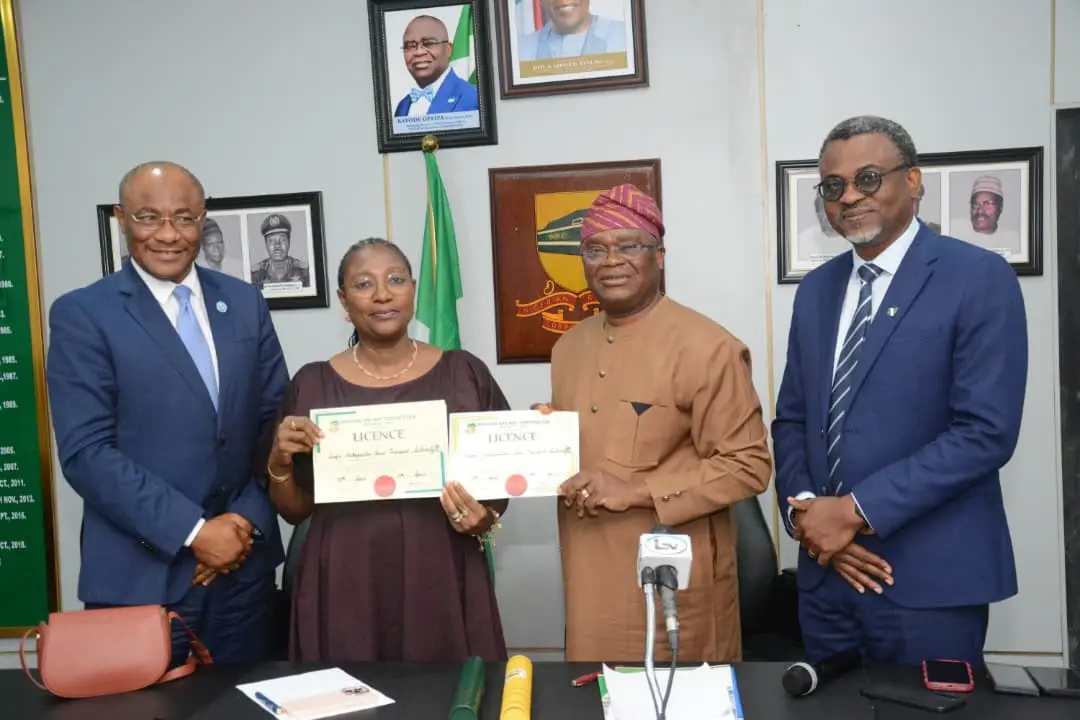
NRC Grants Lagos Permanent Licence to Operate Red Line Rail Services
By OUR REPORTER · 01/07/2026 6:54 PM · 3 min read
The Nigerian Railway Corporation (NRC) has granted the Lagos State Government a permanent operating licence to run the Lagos Rail Mass Transit (LRMT) Red Line, making Lagos the first state in Nigeria authorised to operate both passenger and freight rail services under a regulated rail framework.
The permanent licence, presented on Tuesday by NRC Managing Director Kayode Opeifa, authorises the Lagos State Government to continue operating the Red Line under the existing Track Sharing Agreement between the state and the corporation.
The presentation was attended by officials of the Lagos State Government and the Lagos Metropolitan Area Transport Authority (LAMATA).
Speaking at the ceremony, Opeifa described the approval as a major milestone for Nigeria’s railway sector, saying it represents a transition from the NRC’s long-standing role as the country’s sole rail operator to a regulated system that accommodates multiple operators.
According to him, the licence not only allows LAMATA to continue operating services along the shared rail corridor but also empowers the Lagos State Government to operate other rail systems in line with international best practices.
Opeifa recalled that former President Goodluck Jonathan approved the transfer of two federal railway tracks to the Lagos State Government in April 2012 for the development of the LRMT Red Line, describing the decision as the foundation of one of Nigeria’s most significant urban rail projects.
He noted that passenger operations on the Red Line officially commenced on October 15, 2024, following its inauguration by President Bola Tinubu, adding that the NRC supported the project through technical collaboration and personnel training.
The NRC managing director explained that Lagos had initially been issued a temporary operating licence to facilitate implementation of the Track Sharing Agreement while operational assessments were being conducted.
He said the successful completion of those assessments cleared the way for the issuance of the permanent licence.
Opeifa commended the Lagos State Government for its sustained investment in railway infrastructure, rolling stock and public transportation, describing the state’s achievements as evidence of strong political commitment and long-term planning.
He stressed that rail transportation remains the backbone of efficient urban mobility across major cities worldwide and urged other state governments to invest in rail infrastructure to complement the Federal Government’s efforts to modernise Nigeria’s railway network.
According to him, expanding rail services nationwide would help reduce traffic congestion, lower logistics costs, improve passenger mobility, stimulate economic activities and support national development.
He also praised the assessment team whose evaluations led to the approval of the permanent licence, saying their professionalism ensured the Red Line met all required operational standards.
Opeifa reaffirmed the corporation’s commitment to working with state governments and other stakeholders to build an integrated, safe and sustainable railway system across the country.
In her remarks, LAMATA Managing Director Abimbola Akinajo welcomed the development, describing the permanent licence as the culmination of years of collaboration between the agency and the NRC.
She said the partnership had enabled Lagos to become the first sub-national government in Nigeria authorised to operate the full complement of railway services.
Akinajo added that LAMATA would continue to rely on the NRC’s technical guidance as the Lagos State Government advances its intermodal transportation agenda under Governor Babajide Sanwo-Olu’s THEMES PLUS programme.
She disclosed that the state had already acquired three additional rolling stocks in anticipation of the permanent licence, a move that will increase Red Line services from the current nine daily trips to 24.
According to her, once fully operational, the LRMT Red Line is projected to transport more than 200,000 passengers daily, significantly improving mobility across Lagos while strengthening the state’s public transportation network.
Written by
Our Reporter
SkyHigh NewsHub correspondent.