
Middle East On Edge As US-Iran Hostilities Intensify For Second Consecutive Day
By OUR REPORTER · 11/06/2026 9:59 AM · 2 min read
The United States and Iran have exchanged fresh military strikes across the Middle East for a second consecutive day, raising fears of a broader regional conflict and further weakening a fragile ceasefire agreement reached earlier this year.
The latest escalation began after the United States Central Command (CENTCOM) announced a series of what it described as self-defence strikes against Iranian military facilities, surveillance installations and radar systems in southern Iran.
The operation came shortly after U.S. President Donald Trump warned that Washington would intensify military pressure on Tehran if negotiations aimed at ending hostilities continued to stall.
“We hit them hard yesterday and we're going to hit them hard again today,” Trump declared, accusing Iran of delaying efforts to reach a lasting peace agreement.
Iran responded swiftly, launching retaliatory attacks against American military assets across the region.
According to Iranian state media, the Islamic Revolutionary Guard Corps (IRGC) fired ballistic missiles at U.S. military facilities in Bahrain, Kuwait and Jordan.
The IRGC claimed that a missile barrage targeted the Muwaffaq Salti Airbase in Jordan, alleging significant damage to American military infrastructure and aircraft. Those claims have not been independently verified.
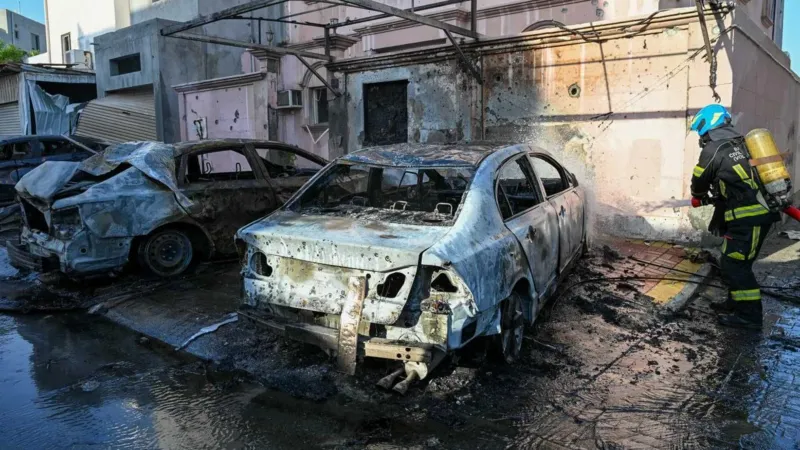
Authorities in Bahrain confirmed that air raid sirens were activated overnight following incoming attacks. Falling debris reportedly damaged homes and vehicles in parts of the country, while an 11-year-old girl sustained minor injuries.
Kuwait also reported intercepting aerial threats and temporarily closed its airspace as a precautionary measure. The renewed confrontation has extended beyond military targets.
Iranian media reported that the IRGC struck two oil tankers in the Strait of Hormuz, one of the world’s most important energy shipping routes. Reports also emerged suggesting Iran had declared the strategic waterway closed to maritime traffic.
However, U.S. military officials disputed those claims, insisting commercial vessels continued to navigate the route.
The uncertainty surrounding shipping operations immediately rattled global energy markets. Brent crude prices surged toward $95 per barrel, while investors increasingly worried that prolonged disruptions could affect global oil supplies and further fuel inflation.
The latest hostilities come months after Washington and Tehran agreed to a temporary ceasefire intended to halt a period of intense military confrontation.
Although both countries largely avoided full-scale conflict after the agreement, sporadic exchanges of fire have continued, preventing meaningful progress toward a permanent settlement.
Diplomatic efforts have suffered additional setbacks in recent weeks, particularly after a U.S. military helicopter was reportedly shot down in an incident blamed on Iran.
The growing instability has drawn international concern.
United Nations Secretary-General António Guterres warned that the region was drifting closer to a wider crisis.
“The ceasefire is more like a lesser-fire,” Guterres said, urging both nations to return to diplomacy before the conflict spirals further out of control.
As military tensions mount and peace negotiations remain stalled, analysts warn that the Middle East could be entering one of its most dangerous periods in recent years.
Written by