
FG Proposes Scrapping JSS-SSS Split to Reduce School Dropout Rate
By OUR REPORTER · 01/07/2026 10:01 AM · 3 min read
The Federal Government has unveiled plans to reform Nigeria's secondary education system by eliminating the distinction between Junior Secondary School (JSS) and Senior Secondary School (SSS), in a move aimed at reducing the country's high school dropout rate and improving student retention.
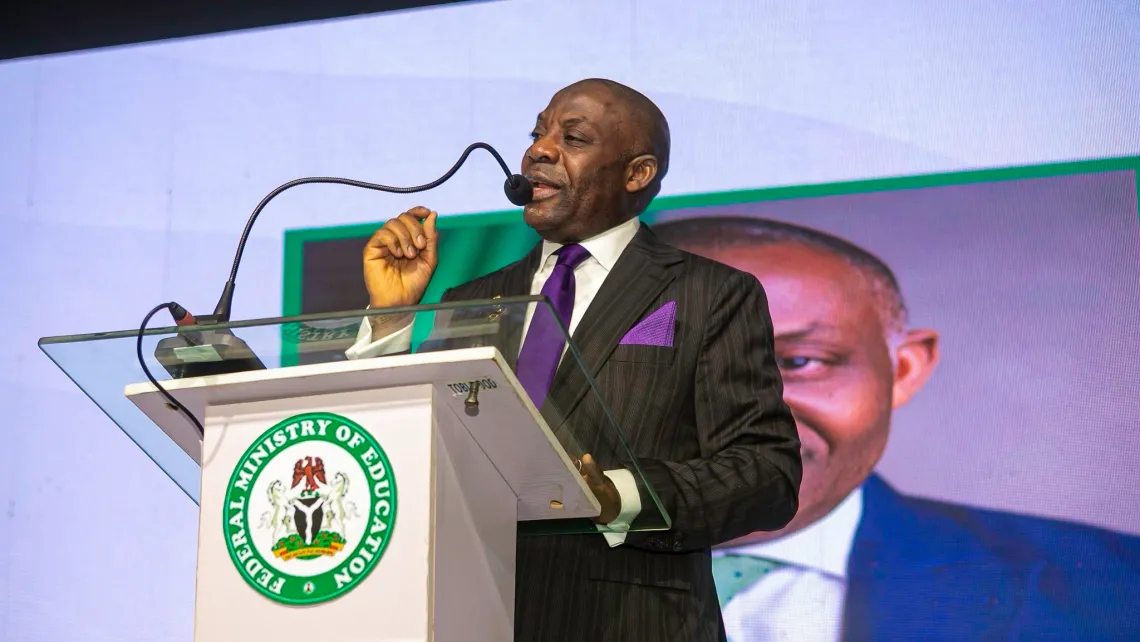
The proposal, announced by the Minister of Education, Dr. Tunji Alausa, seeks to create a more seamless transition through secondary education, addressing what the government describes as a major structural gap that has contributed to millions of Nigerian children leaving school before completing their education.
Speaking on Tuesday during the inauguration of the Ministerial Implementation and Monitoring Committee of the Universal Basic Education Commission (UBEC) in Abuja, Alausa said the proposal would be presented to the National Council on Education (NCE) Nigeria's highest education policy-making body for consideration.
Nigeria currently operates the 6-3-3 structure, under which pupils spend six years in primary school, three years in junior secondary school and another three years in senior secondary school.
At the end of JSS3, students sit for the Basic Education Certificate Examination (BECE) before progressing to senior secondary school, where they eventually write the Senior School Certificate Examination (SSCE).
According to the minister, the transition between junior and senior secondary education has become one of the weakest points in the country's education system, with millions of children dropping out before completing their secondary education.
"About 24 million children are enrolled in our primary schools, but only about four million of them complete senior secondary. We have over 20 million children dropping out between primary school and junior secondary school," Alausa said.
He added:
"We have overflowing junior secondary schools and empty senior secondary schools."
The minister argued that restructuring the system could improve continuity, keep more children in school and ultimately strengthen Nigeria's human capital development.
Alausa also pointed to the imbalance in educational infrastructure as another factor affecting retention.
According to him, Nigeria currently has more than 80,000 public primary schools, compared to only about 15,000 junior secondary schools, creating enormous pressure on available facilities as pupils move through the education system.
He said addressing these structural bottlenecks is essential if Nigeria is to improve access to education and reduce the number of children leaving school prematurely.
The proposed reform comes against the backdrop of Nigeria's long-standing struggle with one of the world's largest populations of out-of-school children.
Despite years of interventions by successive administrations and development partners, millions of school-age children remain outside the formal education system, while many others fail to complete basic or secondary education.
To address the challenge, the Federal Government has implemented several programmes, including the Better Education Service Delivery for All (BESDA) initiative and the Adolescent Girls Initiative for Learning and Empowerment (AGILE), both supported by the World Bank.
While the programmes have expanded access to education in some parts of the country, authorities acknowledge that the overall challenge remains significant.
Beyond structural reforms, the government is also investing in education data management to improve planning and policy implementation.
One of the latest initiatives is the introduction of the Learner Identification Number (LIN), which provides every Nigerian student with a permanent academic identity throughout their educational journey.
The government is also preparing to roll out the Digital National Education Management Information System (DNEMIS), a centralised digital platform designed to consolidate data on schools, learners and educational institutions across the country.
According to the National Project Coordinator of the Special Programmes Operations and Implementation Unit in the Office of the Minister of Education, Adebayo Onigbanjo, more than 32 million students have already been enrolled on the DNEMIS platform.
The proposal to remove the separation between junior and senior secondary education has not yet been adopted as government policy.
It will first be presented to the National Council on Education, the country's highest education policy-making body comprising federal and state education commissioners, permanent secretaries and key stakeholders.
If approved, the reform could lead to one of the most significant changes to Nigeria's secondary education structure in decades, with the government hoping it will improve school retention, reduce dropout rates and ensure more children complete their secondary education.
Written by
Our Reporter
SkyHigh NewsHub correspondent.