
Escaping Bandits And Still Branded A Bandit: How Fulani Endure Violence And Suspicion
By MEEMA SAAHIB · 14/07/2026 8:46 PM · 7 min read
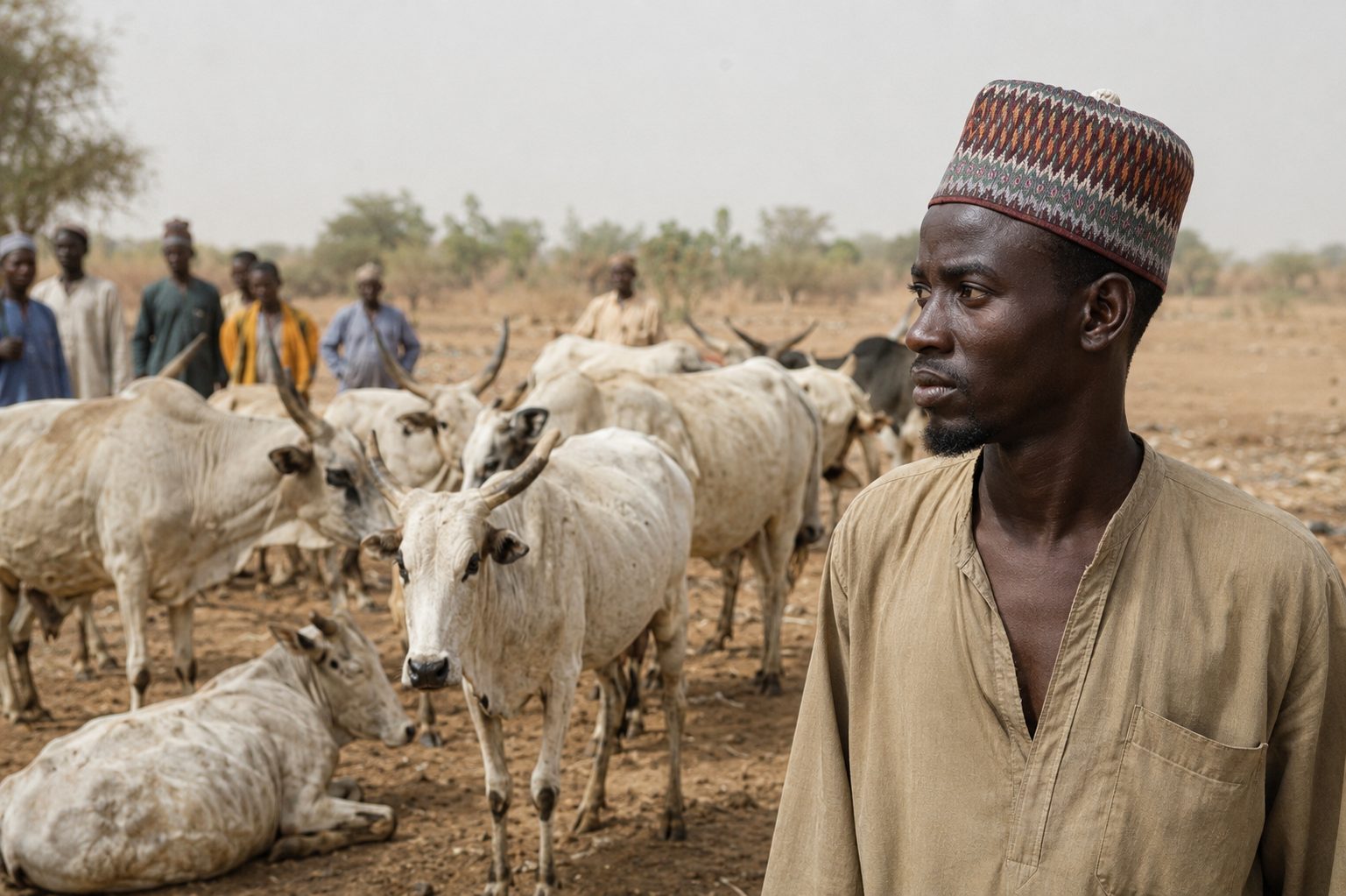
For Amadu Mande, a young Fulani pastoralist, escaping a bandit attack should have marked the end of his nightmare. Instead, it became the start of another.
One afternoon in April 2025 while grazing his family's cattle near Jangebe village in Mafara Local Government Area of Zamfara State, armed bandits emerged from the bush and drove away his family's entire herd, wiping out the wealth they had built over generations.
Having no way to resist, Mande, 27, fled for cover and hid himself until the gunmen disappeared.
Hours later, exhausted and traumatised, a passerby helped him board a truck, hoping the driver would drop him at the nearest police station or checkpoint. Instead, the truck stopped beside a local vigilante group (Yan Sakai)
“Rather than protecting me, they beat me and accused me of being a bandit." Mande recounted. His desperate attempts to explain that he had just escaped an attack fell on deaf ears. He was held over the night by the vigilante group, who insisted he contact relatives who could pay money before he was eventually released.
"I escaped from bandits only to be treated like one," he said.
Mande's experience reflects a growing but little-understood reality across the banditry-ravaged northwestern Nigeria. As insecurity has spread, many innocent Fulani families say they have become trapped between two fires: terrorized by armed bandits on one side and viewed with suspicion because of their ethnicity on the other. For them, surviving violence does not always bring safety. It often ushers in a second ordeal of having to prove they are not criminals.
Among them is Auwal Hameidu.
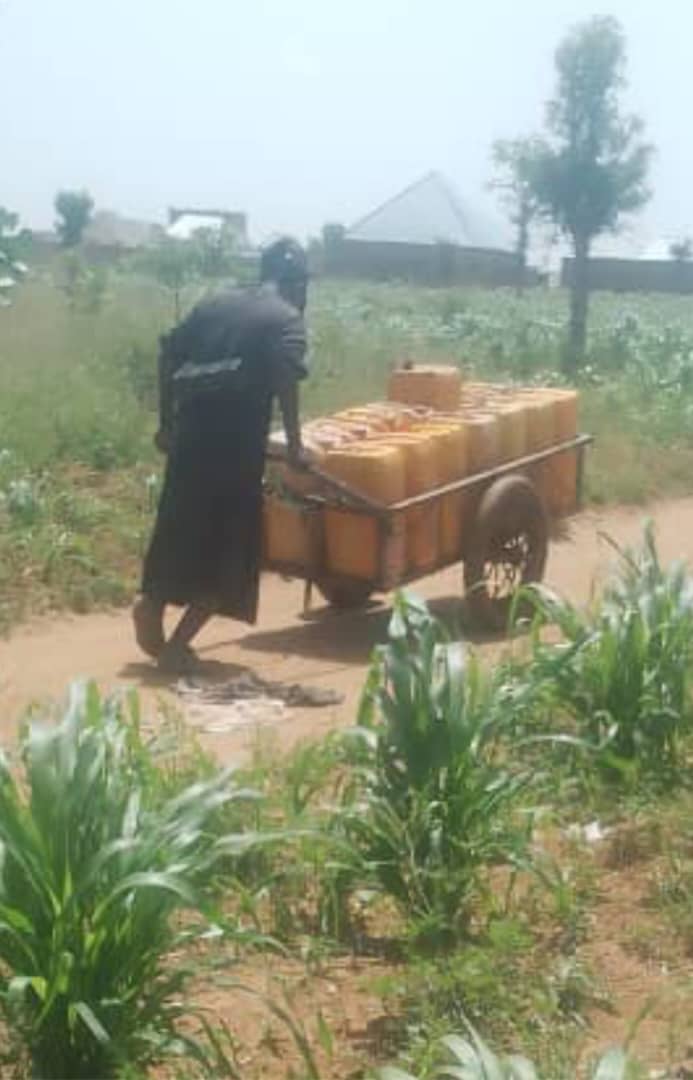
Every morning before sunrise, Hameidu pushes a wooden cart loaded with yellow jerrycans through the streets of Sokoto.
To most residents, he is simply Mai Ruwa-the water seller. Few know that only a few years ago, he was a respected cattle owner with a large herd grazing across the plains.
Among the Fulani, cattle are far more than livestock. They are a symbol of identity, inheritance, dignity, and a family's entire livelihood.
As he strains to push his cart along the dusty road, Haimedu pauses and reflects on the life he has lost.
He recalled how armed bandits stormed his village of Lambar Raba on a Thursday evening and rustled his herd of cattle.
The attack forced his family to flee for safety, leaving behind everything they had built over the years and shattering a family legacy that had taken decades to establish.
Overnight, a prosperous pastoralist has become a displaced man struggling to survive.
Today, Hameidu, his wife, and two children live in an uncompleted building on the outskirts of Sokoto. To feed his family, he now earns a modest income selling water, a reality he describes as both “painful and humiliating”
But losing his cattle was only the beginning of his ordeal.
As insecurity spread across northwestern Nigeria, another burden emerged that could not be measured in stolen livestock or lost income.
"When people see a Fulani man, many immediately think we are all bandits," Hameidu said quietly, fixing his gaze on a Neem tree beside him.
"People think we benefit from banditry, many of us are victims of the same insecurity we are accused of causing”
For him, the pain of displacement has been compounded by the weight of suspicion, and the burden of constantly convincing strangers that he is not a criminal.
His experience reflects a growing reality for many innocent Fulani families who, after becoming victims of bandit attacks themselves, now find themselves trapped between two fires of being terrorized by criminals on one side and judged by society on the other.
Across northern Nigeria, thousands of innocent Fulani families say they are caught in a crisis with no ‘safe side’.
“Armed bandits raid our settlements, kidnap us, steal our cattle, force us to flee our homes and in worst cases kill us” Hameidu added
No Safe Side
According to the International Organization for Migration, nearly 3.5 million Nigerians are internally displaced by conflict and violence, illustrating the scale of the humanitarian crisis unfolding across the country.
Their fears have grown alongside the region's worsening security crisis. According to the European Union Agency for Asylum (EUAA), bandit violence spread from Zamfara into Sokoto and other northwestern states, escalating significantly between 2017 and 2018.
What began as localized farmer-herder disputes gradually evolved into organized criminality characterized by mass kidnappings, cattle rustling, village raids, and widespread displacement.
EVEN FULANI ARE KIDNAPPED
Zainab Musa, a mother of one, said ethnicity offered no protection.
She had lived peacefully with her family until armed kidnappers stormed the community.
"It was on a Sunday. I had just returned from grazing nearby when they stormed our compound and demanded to know where our household head was. I told them I didn't know where he was. They took me away with them and beat me repeatedly for several days”
“Although I eventually regained my freedom when they (kidnappers) realised that I do not have the means for ransom but even with that the emotional scars remain”
According to her, some of the abductors spoke Fulfulde, making the experience even more heartbreaking.
"It made me realise that these criminals do not care who you are, They attack anyone." She said while shaking her head in dismay.
Her experience challenges one of the most persistent assumptions surrounding Nigeria's insecurity that Fulani communities are insulated from the violence carried out by armed groups.
The suspicion Haimedu and Amadu encounter is not confined to village roads or security checkpoints.
Researchers say similar stereotypes have increasingly spread online.
In 2022, HausaNLP researchers introduced HERDPhobia, the first annotated dataset dedicated to documenting hate speech directed at Fulani people in Nigeria, suggesting anti-Fulani rhetoric has become significant enough to require dedicated academic study.
Conflict analyst Bashar Altine says ethnic profiling is not only unjust but can also undermine efforts to restore peace.
According to him, innocent Fulani pastoralists increasingly find themselves punished for crimes committed by individuals with whom they have no connection.
He said that the burden extends beyond attacks by armed groups and discrimination from neighbouring communities.
Altine says some law-abiding herders also report losing their livestock during security operations targeting bandits.
"In some cases, innocent pastoralists struggle to prove ownership after cattle are recovered or confiscated during operations," he said.
"Affected communities allege that genuine owners sometimes lose their animals because they are presumed to belong to criminal groups."
According to him, such experiences deepen mistrust between pastoral communities and state institutions.
"If a man loses part of his herd to bandits and then loses the rest because he is unable to prove ownership or is viewed with suspicion, the state has unintentionally compounded the injustice already inflicted by criminals"
He recommends a transparent verification process that allows genuine owners to establish ownership before confiscated livestock is auctioned, redistributed or otherwise disposed of.
He also argues that protecting innocent pastoralists is not only a human rights issue but a security imperative.
"Communities are more willing to cooperate with security agencies when they believe they will be treated fairly," collective suspicion weakens trust and makes intelligence gathering more difficult.”
Security agencies have consistently maintained that operations against banditry and cattle rustling are conducted within the law and that recovered livestock are handled through established procedures.
NO CITIZENS SHOULD FACE COLLECTIVE BLAME BECAUSE OF IDENTITY
Col. Ahmed Usman Rtd, the special advisor to the Sokoto State Governor on Security warned that criminal responsibility is individual, not ethnic.
He said while authorities continue pursuing armed groups responsible for terrorising communities, innocent civilians must be protected from collective blame
“The government is aware of reports of injustice affecting individuals and communities in our society. Let it be known that no citizen or community should suffer injustice, marginalization, or violations of their rights”
He said that the security architecture is on alert to ensure that law and order are maintained, and that every person is protected under the law.
“We urge anyone facing injustice to report through the appropriate legal and security channels so that prompt action can be taken”
“We also call on community leaders to promote dialogue, tolerance, and peaceful coexistence”
The administration of Governor Ahmed Aliyu remains committed to justice, equity, and the security of lives and property for all residents of Sokoto State” he concluded
Written by
Meema Saahib
SkyHigh NewsHub correspondent.