
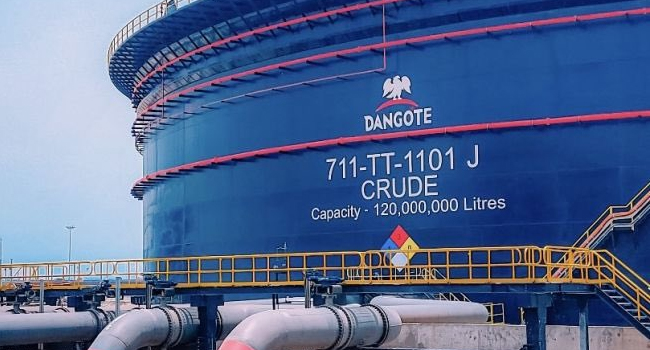
Dangote Dismisses Re-Importation Allegations, Says Fuel Claims Defy Market Logic
By OUR REPORTER · 24/06/2026 9:29 AM · 3 min read
Dangote Petroleum Refinery and Petrochemicals has dismissed claims that its petroleum products are exported to neighbouring countries and subsequently re-imported into Nigeria, describing the allegations as false, misleading and inconsistent with commercial realities.
In a statement issued on Wednesday, the refinery said it was compelled to respond because of what it described as the circulation of unfounded reports suggesting that products refined at its facility are shipped to Lomé, Togo, before finding their way back into the Nigerian market.
The company said the allegation lacks credible evidence and does not align with established trade practices, contractual obligations or economic realities.
According to the refinery, its primary objective remains strengthening domestic fuel supply and reducing Nigeria's dependence on imported petroleum products.
It argued that facilitating the re-importation of its own products would directly undermine that objective and create unnecessary competition for its domestic operations.
“Management states unequivocally that the allegation is not supported by verifiable trade data, commercial logic or the operational realities of Dangote Refinery,” the statement said.
The company explained that all its sales agreements and export contracts contain provisions that expressly prohibit the resale or re-importation of Dangote Refinery products into Nigeria.
It noted that such restrictions are built into contractual frameworks to ensure compliance with its market objectives and supply strategy.
Dangote Refinery also challenged the economic viability of the alleged trade arrangement.
According to the company, transporting petroleum products from its facility to Lomé and subsequently returning them to Nigeria would incur logistics costs estimated at between $82 and $90 per metric tonne.
The refinery said such expenses would significantly reduce profitability and make the entire transaction commercially unattractive.
“Dangote Refinery does not provide export discounts sufficient to offset these costs or create arbitrage opportunities between export and domestic markets,” the statement added.
“Simply put, no rational producer would incur additional shipping, storage, financing and handling costs only for products to re-enter and compete in its primary market.”
The company further stated that it maintains extensive product monitoring and traceability systems throughout its supply chain.
These measures include detailed documentation covering lifting points, vessels used for transportation, counterparties involved in transactions and declared destinations for all exported products.
According to the refinery, these procedures ensure full visibility and accountability from the point of loading to final delivery.
It said any suggestion that it permits or encourages re-importation contradicts both its compliance systems and contractual safeguards.
The company reiterated that it has consistently advocated policies aimed at strengthening local refining capacity and reducing Nigeria's exposure to fuel imports.
It argued that encouraging re-importation would not only undermine local refining investments but could also place additional pressure on the country's foreign exchange reserves and weaken broader industrial development efforts.
“Management underscores that encouraging or enabling re-importation would undermine local refining efforts, strain foreign exchange reserves and weaken national industrial growth, positions that are contrary to its core objectives,” the statement said.
Dangote Refinery maintained that there is no strategic, economic or operational basis for the allegations and insisted that the claims do not withstand scrutiny when examined against prevailing market conditions and industry practices.
The company said it remains focused on its long-term objective of enhancing Nigeria's energy security, expanding local refining capacity and supporting industrial development across Africa.
The refinery concluded by reaffirming its commitment to supplying quality petroleum products to the domestic market while contributing to the broader goal of reducing Africa's dependence on imported refined products.
Written by
Our Reporter
SkyHigh NewsHub correspondent.