
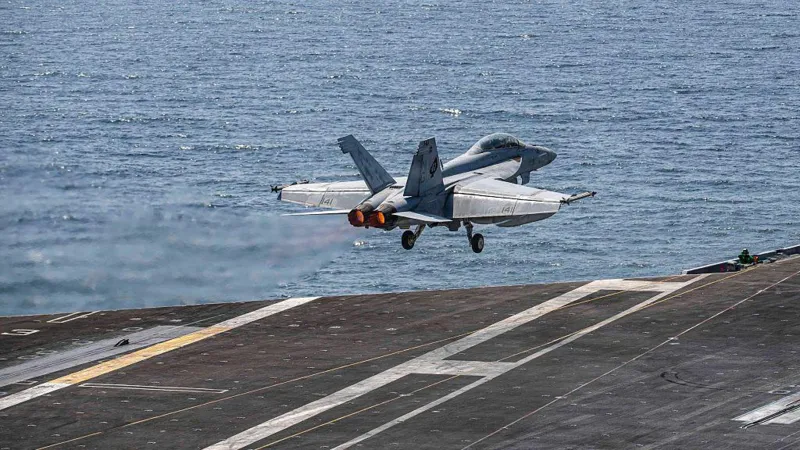
US Strikes Iranian Military Site As Tehran Targets American Base
By OUR REPORTER · 28/05/2026 8:53 AM · 3 min read
Fresh tensions have erupted in the Middle East after the United States launched military strikes on an Iranian military facility in Bandar Abbas, prompting retaliatory action from Tehran amid fears that a fragile ceasefire could collapse completely.
The US military confirmed that the strikes targeted a site in Bandar Abbas, a strategic Iranian port city located near the Strait of Hormuz, one of the world’s most critical global shipping routes.
In response, Iran’s Islamic Revolutionary Guard Corps announced that it had targeted an American military base, although officials did not immediately disclose the exact location of the installation.
Kuwait, which hosts a major US air base, later revealed that its air defence systems intercepted what it described as hostile missile and drone threats, though authorities stopped short of confirming where the projectiles originated from.
The latest exchange marks the second direct military confrontation between the US and Iran within three days.
According to US Central Command, the strike in Bandar Abbas was carried out because Iranian forces were allegedly preparing to launch another drone attack.
Centcom stated that the operation was “measured, purely defensive, and intended to maintain the ceasefire.”
The US military further claimed that American forces intercepted and destroyed four Iranian attack drones near the Strait of Hormuz after identifying them as threats to regional security.
Iran, however, strongly condemned the attacks, describing them as a “grave violation of the ceasefire” and warning that Tehran would not ignore what it called repeated acts of aggression.
Iranian media reported explosions east of Bandar Abbas shortly after the strikes, while the Revolutionary Guard also claimed it shot down a US drone and engaged another American aircraft that allegedly entered Iranian airspace.
Earlier in the week, Washington acknowledged conducting separate strikes in southern Iran targeting missile launch sites and boats allegedly attempting to deploy naval mines in the Strait of Hormuz.
The US insisted those operations were necessary to protect American troops and maintain maritime security in the region.
The Strait of Hormuz remains one of the most sensitive energy corridors in the world, with nearly one-fifth of global oil and liquefied natural gas supplies typically passing through the route.
The ongoing conflict has already disrupted shipping activity and triggered fresh concerns across global energy markets.
Adding to the pressure, the US Treasury Department announced sanctions against the Iranian body responsible for collecting navigation payments from vessels travelling through the Strait.
US Treasury Secretary Scott Bessent accused Iran of attempting to “extort global maritime trade” through its control of the strategic waterway.
Iranian authorities defended the charges collected from vessels, insisting they were legitimate fees for navigational services and maritime management.
The renewed hostilities come as diplomatic negotiations aimed at ending the three-month conflict remain stalled.
US President Donald Trump said during a cabinet meeting on Wednesday that Iran appeared increasingly desperate to reach an agreement but warned that Washington was prepared to resume large-scale military operations if talks failed.
“Maybe we have to go back and finish it, maybe we don’t,” Trump said.
The US president also urged Gulf nations to strengthen regional alliances with Israel through the Abraham Accords as part of broader security arrangements in the Middle East.
Although both Washington and Tehran recently hinted that progress had been made toward a peace deal, hopes for an imminent agreement have since faded.
Iranian state television earlier published what it claimed were details of a draft deal involving the reopening of the Strait of Hormuz and the withdrawal of US forces from parts of the region.
The White House dismissed the reported document as “a complete fabrication.”
Despite diplomatic efforts continuing behind the scenes, tensions remain dangerously high as both sides continue to exchange military threats while the wider region braces for further escalation.
Written by
Our Reporter
SkyHigh NewsHub correspondent.