
US Renews Strikes on Iran for 11th Night as Trump Threatens Nuclear Site Attack
By OUR REPORTER · 22/07/2026 7:54 AM · 4 min read
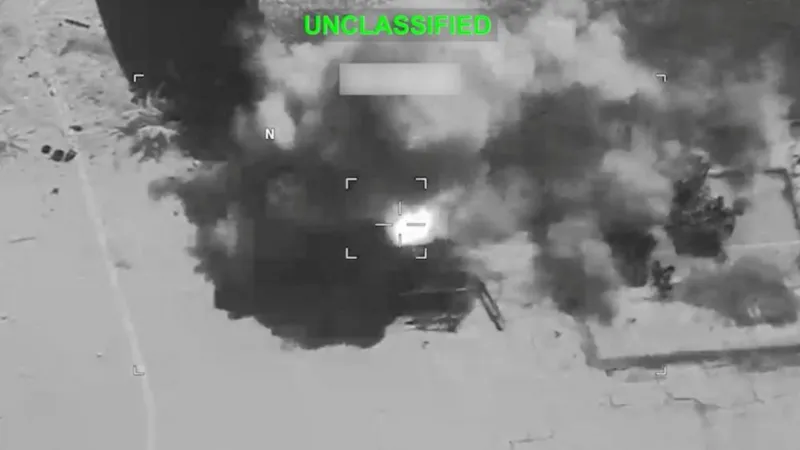
The United States launched a fresh wave of airstrikes against Iran late Tuesday, extending its military campaign to an 11th consecutive night, as President Donald Trump warned that Washington could soon target an underground nuclear facility believed to be linked to Iran's enrichment programme.
The renewed strikes came as Iran warned that any attack on its nuclear infrastructure would significantly escalate the conflict and trigger retaliation against American interests and its regional allies.
The US Central Command (CENTCOM) said the latest operations were aimed at further degrading Iran's military capabilities and limiting its ability to threaten commercial shipping in the strategically vital Strait of Hormuz.
According to CENTCOM, American forces struck military operations centres, maritime assets, aircraft hangars, drone storage facilities and logistics infrastructure.
The command also accused Iran of carrying out attacks on more than 30 commercial vessels transiting the Strait of Hormuz over the past three months.
"The unwarranted attacks have endangered hundreds of innocent mariners and undermined freedom of navigation," CENTCOM said in a statement, adding that the waterway remains open to commercial shipping.
Iranian state media reported that air defence systems were activated in the capital, Tehran, as explosions were heard in several parts of the country.
Local reports said blasts were also recorded in the north-western city of Tabriz, the south-eastern port cities of Chabahar and Konarak as well as Bushehr, home to Iran's only operational nuclear power plant.
Iranian authorities did not immediately disclose the extent of damage or possible casualties.
Speaking during a White House meeting with Lebanese President Joseph Aoun, President Trump said the United States could soon strike a heavily fortified underground nuclear complex known as Pickaxe Mountain, located near Natanz.
The facility is widely suspected by Western intelligence agencies of housing an undeclared uranium enrichment programme.
"We'll be hitting that area pretty soon, and very heavily," Trump told reporters.
He acknowledged that military targets are not normally announced publicly but added, "There's not a thing they can do about it."
The comments represent one of Trump's strongest public warnings since the latest phase of hostilities began.
Iran responded swiftly, with the Khatam Al-Anbiya Central Headquarters, the country's military command, warning that any strike on its nuclear facilities would be viewed as a major escalation.
According to Iran's state broadcaster IRIB, military officials said such an attack would be treated as "an expansion of war in the region" and could result in strikes against "all the interests of America, the allies and supporters."
The warning came amid heightened concern that the conflict could broaden beyond the Gulf.
As the conflict intensified, Kuwait said its air defence systems intercepted Iranian drones overnight.
Bahrain and Jordan also reported intercepting drones and missiles during the latest round of regional attacks.
Trump also warned Iran-backed Houthi rebels in Yemen after the group threatened to blockade Saudi Arabian ports.
"We'll take care of them," Trump said, referring to the Houthis.
Earlier, a Houthi official announced plans to close the Bab al-Mandab Strait, a strategic maritime chokepoint linking the Red Sea with the Gulf of Aden.
The threat has raised fresh concerns over global energy supplies, particularly as the Strait of Hormuz remains under severe disruption.
The growing insecurity has already begun affecting international shipping.
British maritime security consultancy Vanguard reported that two oil tankers carrying Saudi crude to China and India reversed course after loading at Yanbu on the Red Sea, opting instead to head toward the Suez Canal following the Houthi announcement.
The Strait of Hormuz and the Bab al-Mandab together handle a significant share of the world's seaborne oil exports, making continued disruptions a major concern for global energy markets.
The latest escalation follows the collapse of a ceasefire agreed between Washington and Tehran earlier this year.
The two countries signed a Memorandum of Understanding in June aimed at halting military operations, reopening the Strait of Hormuz and negotiating an end to hostilities within 60 days.
However, President Trump declared the ceasefire effectively over after accusing Iran of resuming attacks on shipping in the Gulf, prompting renewed US military action.
The financial burden of the military campaign also continues to grow.
Appearing before the US Senate Appropriations Committee on Tuesday, Defence Secretary Pete Hegseth said the conflict has now cost the United States approximately $37.5 billion, nearly $8 billion more than previous estimates released in May.
Hegseth warned lawmakers that military training and readiness programmes could face cutbacks unless Congress approves additional emergency funding.
With both Washington and Tehran hardening their positions and threats expanding beyond the Gulf into the Red Sea, diplomats fear the conflict could enter an even more dangerous phase with wider implications for regional security, global trade and energy supplies.
Written by
Our Reporter
SkyHigh NewsHub correspondent.