
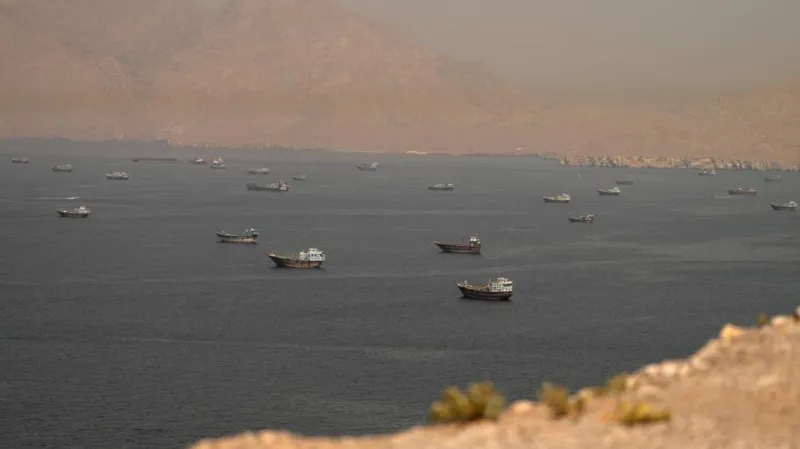
US Launches Massive Strikes on Iran After Tanker Attacks in Strait of Hormuz
By OUR REPORTER · 08/07/2026 7:35 AM · 4 min read
The United States and Iran have exchanged fresh military strikes, marking a sharp escalation in tensions across the Gulf after attacks on commercial oil tankers in the strategically vital Strait of Hormuz.
The latest confrontation began after the United States Central Command (CENTCOM) announced on Tuesday that it had carried out what it described as "powerful" strikes against more than 80 Iranian military targets in response to attacks on three commercial oil tankers operating in the Strait of Hormuz.
According to CENTCOM, the operation targeted missile launch sites, command-and-control facilities and dozens of small attack boats allegedly linked to the attacks on international shipping.
The US military said the strikes were intended to impose "heavy costs" on those responsible for targeting commercial vessels navigating one of the world's busiest maritime trade routes.
Although Iran has not directly claimed responsibility for the tanker attacks, Tehran responded on Wednesday by announcing missile and drone strikes against US military installations in Bahrain and Kuwait.
Iran's Islamic Revolutionary Guard Corps (IRGC) said it launched attacks on 85 US military facilities, including a US Navy headquarters in Bahrain and an American air base in Kuwait.
Iranian officials said the attacks were retaliation for what they described as unlawful US aggression.
Iran's state media reported that US strikes hit areas including Qeshm Island, Bandar Abbas and Sirik, with several people reportedly injured by shrapnel.
Iran's Parliament Speaker, Mohammad Bagher Ghalibaf, accused Washington of violating the memorandum of understanding signed by both countries last month.
He alleged that the United States breached the agreement through military operations near the Strait of Hormuz, renewed oil sanctions and continued threats of further attacks.
"The era of bullying and extortion is over. It leads nowhere. We don't fold," Ghalibaf said.
Earlier, Iran's Deputy Foreign Minister had also described the American strikes as a violation of the bilateral agreement and warned that Tehran would take what it called "decisive measures" to protect its national security.
Before launching the military operation, Washington revoked a sanctions waiver that had temporarily eased restrictions on Iran's oil sector under the memorandum of understanding reached between both countries last month.
Iran's Foreign Ministry condemned the decision, describing it as evidence of Washington's "bad faith, inconsistency and unreliability."
The ministry insisted that Tehran would take whatever measures it deemed necessary to safeguard its national interests.
The renewed conflict has drawn international attention.
NATO Secretary General Mark Rutte defended the US military response, describing it as justified.
"I think it was absolutely necessary," Rutte said while attending the NATO summit in Ankara, arguing that Iran had violated the ceasefire through attacks on commercial vessels.
Regional tensions have also intensified following accusations from Gulf states.
Qatar and Saudi Arabia both alleged that tankers linked to their countries were struck while transiting through or near the Strait of Hormuz, blaming Iran for the incidents.
Qatar's Foreign Ministry said Iran was "fully responsible" for an apparent attack on a vessel identified as Al-Rekayyat, while Saudi Arabia accused Tehran of targeting the tanker Wadyan.
Iran rejected the accusations.
Foreign Ministry spokesman Esmail Baghaei described Qatar's claims as inconsistent with the principle of good neighbourliness and argued that vessels operating outside routes coordinated with Iranian authorities or tampering with tracking systems could face navigation risks.
The United Kingdom Maritime Trade Operations (UKMTO) also reported multiple security incidents involving commercial vessels in the Strait of Hormuz.
According to the organisation, one tanker caught fire after being struck by an unidentified projectile, while two other vessels sustained varying degrees of damage but continued their voyages.
The latest exchange of military strikes comes despite ongoing diplomatic efforts to preserve a ceasefire framework agreed between Washington and Tehran last month.
Under the 14-point memorandum of understanding, Iran and Oman were expected to hold discussions with other Gulf states on the future administration and maritime management of the Strait of Hormuz.
The waterway remains one of the world's most strategically important shipping lanes, carrying a significant share of global oil exports, making any escalation in the region a major concern for international energy markets and global security.
Written by
Our Reporter
SkyHigh NewsHub correspondent.