
State Police in Nigeria: Promise, Pitfalls and the Safeguards Needed for Success
By DAVID DICKSON · 11/07/2026 1:22 PM · 8 min read
For decades, the call for the establishment of state police remained one of the most contentious issues in Nigeria’s political and security discourse. Successive administrations either avoided the subject or argued that the country was not yet prepared for decentralised policing, citing fears of political interference and abuse by state governments.
However, with insecurity becoming increasingly widespread and sophisticated, the debate assumed renewed urgency.
From terrorism and kidnapping to armed robbery, communal clashes and attacks on rural communities, many Nigerians believed the country’s centralised policing structure was struggling to meet the growing security demands of a nation of more than 200 million people.
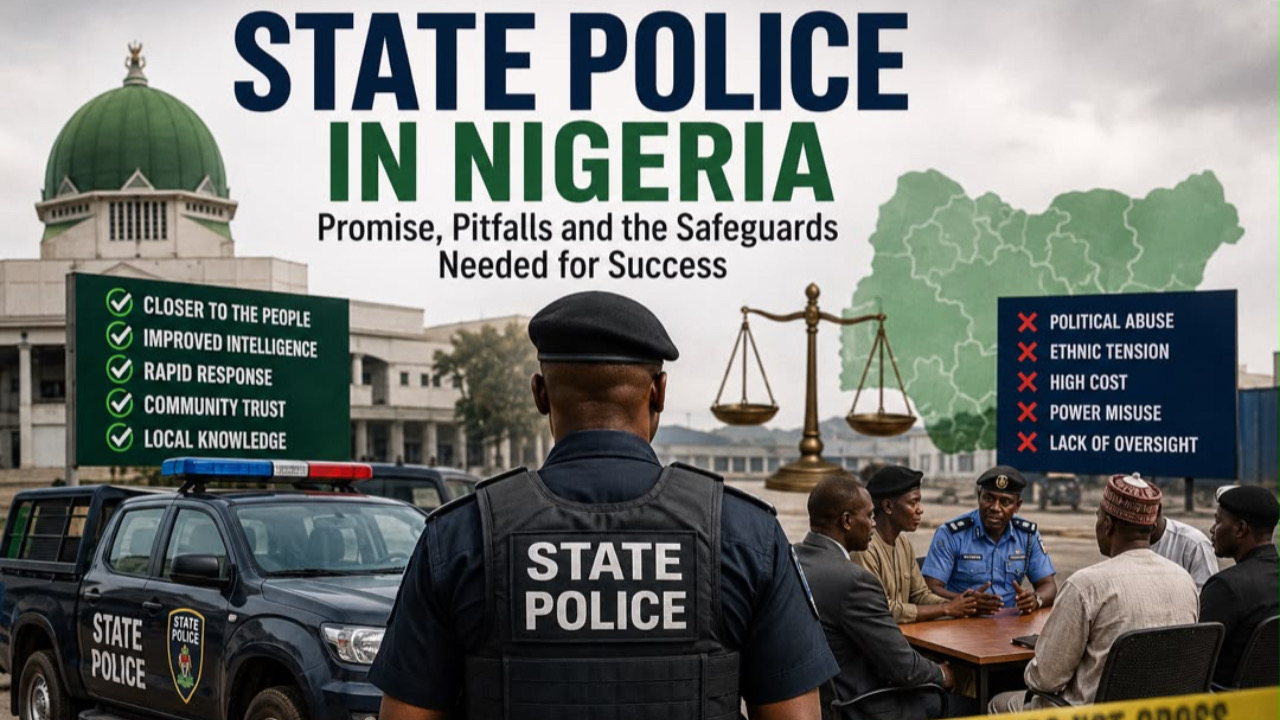
Although the proposal to establish state police continued to divide public opinion, supporters maintained that it would bring policing closer to the people, improve intelligence gathering and strengthen grassroots security. Critics, however, argued that unless adequate constitutional safeguards were put in place, governors could exploit state-controlled police for political purposes.
Among those who believed the time had come for Nigeria to embrace the reform was veteran broadcast journalist, Dr. Paul Anthony Emohare, who described the initiative as a long-awaited step towards addressing many of the country’s security challenges.
Speaking during an interview with SkyHigh NewsHub’s David Dickson, Emohare said he welcomed the development after learning that the proposal had advanced through the legislative process.
According to him, the demand for state police was not new but one that many Nigerians had advocated over the years because of the limitations associated with the country’s centralised policing system.
“The state police has been a long run of what people have been craving and longing for in Nigeria. I was so happy when I heard that it had finally been passed as a bill in Nigeria,” he said.
For the veteran journalist, one of the strongest arguments in favour of state police lay in the familiarity local officers would have with the communities they served.
He noted that effective policing extended beyond uniforms and weapons, stressing that local knowledge often determined whether criminals were apprehended or escaped justice.
According to him, officers recruited from within their respective states understood the terrain, language and people far better than personnel transferred from distant parts of the country.
He argued that while transfers remained an important feature of policing, deploying officers to unfamiliar environments frequently created operational difficulties, particularly in communities where local knowledge played a vital role in intelligence gathering and crime detection.
“When you commit crime, those people who are on the ground, who are in the state, can actually trace their way out of where and how to arrest people. Not where you have policemen being transferred from Kano, Kaduna or Damaturu down to Ibadan to come and work. They don’t know the terrain; they don’t know the paths,” he said.
Emohare maintained that successful policing depended largely on understanding the environment in which crimes occurred.
Drawing from the popular saying that “it takes a thief to catch a thief,” he explained that local officers often possessed a better understanding of how criminals operated within their communities, making intelligence gathering more effective.
He added that beyond enforcing the law, state police would strengthen relationships between security agencies and local communities because personnel would serve among people they knew and understood.
“When you say state policing, I quite agree. I actually embraced it with so much hope because that is where we can know ourselves,” he added.
Emohare also linked the state police debate to the persistent challenge of kidnapping across different parts of the country.
He argued that many rescue operations were delayed because security personnel deployed to affected areas often lacked sufficient knowledge of forests, villages and remote routes frequently used by criminal gangs.
Using kidnapping incidents in forest communities as an example, he said local knowledge could significantly improve search and rescue operations.
“It takes people who know the paths to tread those paths. There are people who understand the forests and the communities better than anyone else. Those are the people that can help security agencies locate where criminals hide,” he said.
According to him, state police would make it easier to recruit individuals with extensive knowledge of difficult terrains, particularly forests where kidnappers often established camps beyond the reach of conventional security patrols.
He also pointed to the contributions of local hunters and vigilante groups in tracking criminal gangs in some communities, saying their experience should not be overlooked.
“There are hunters who go deep into the forests every day. They know the terrain because that is where they hunt. These are people who understand those environments, and I think they can become valuable assets within a properly organised state police structure,” he said.
The broadcast journalist acknowledged that introducing state police would not be without challenges.
He noted that every major institutional reform experienced initial difficulties but expressed confidence that the system would gradually become more efficient as states established legal frameworks and operational structures suited to their peculiar circumstances.
“The construction might be a bit difficult at the beginning, but each state will sit down, make the necessary laws through its House of Assembly and develop what is suitable for its own terrain,” he said.
He stressed that Nigeria’s diverse geographical and cultural realities made a one-size-fits-all policing model increasingly difficult to sustain.
According to him, security challenges differed from one state to another, making localised solutions necessary.
“What is obtainable in one state cannot be obtainable in another because the terrains are different,” he noted.
Emohare also dismissed suggestions that state police would weaken federal authority.
Rather, he argued that both systems could operate simultaneously, with the Federal Government retaining responsibility for national security while state police focused on maintaining law and order within their respective jurisdictions.
He compared the proposed arrangement to policing structures in countries operating federal systems of government.
“Look at the United States. They have state police apart from the federal authorities. The Federal Government still oversees national security while each state manages its own policing responsibilities. That is something Nigeria should have embraced long ago,” he said.
Addressing concerns that state police could lead to jurisdictional conflicts among security agencies, Emohare said clearly defined operational boundaries would prevent unnecessary overlap.
He explained that state police should operate strictly within their respective states, while federal security agencies retained jurisdiction over offences affecting national security or extending across state boundaries.
“State police should remain within the state. They should not move into another state to begin operations. The Federal Government will still be there to coordinate national security and provide overall supervision,” he said.
Despite reservations expressed by critics, Emohare remained optimistic that the reform would strengthen Nigeria’s security architecture if implemented with sincerity, proper planning and adequate legal safeguards.
“I can tell you this state police will work. At the initial stage there may be some challenges, but once the system stabilises and every state develops its own policing structure, Nigerians will begin to appreciate its benefits,” he said.
However, as the campaign for state policing gathered momentum across the country, critics warned that the proposal could inadvertently destabilise Nigeria if not carefully implemented.
They argued that the country’s structural, financial and political realities made the establishment of sub-national police forces a risky undertaking capable of encouraging abuse, undermining democratic institutions and exacerbating regional tensions.
One of those expressing such concerns was Prof. Akinfemi Oladele, a Professor of Political Science, who argued that Nigeria’s political system lacked the institutional maturity required to ensure that state police remained impartial and accountable.
“We cannot separate the structural architecture of policing from the political culture of those who will control it. In our current political climate, state police will almost certainly be weaponised as an instrument of political coercion rather than public safety,” he said.
Oladele warned that placing armed police forces under the control of state governors could encourage political intimidation, suppress opposition and weaken democratic checks and balances.
He also expressed concern over the financial implications of maintaining state police, noting that many states already struggled to pay workers’ salaries. According to him, poorly funded police commands could worsen corruption and erode professionalism.
The political scientist further cautioned that state police could deepen ethno-religious tensions in multi-ethnic states, where minority groups might fear discrimination by state-controlled security agencies.
He argued that strengthening and reforming the existing Nigeria Police Force remained a safer and more sustainable option than creating separate state police commands.
“The solution to a leaking roof is not to demolish the foundation of the house. Before we rush into creating thirty-six separate armed commands, we must first exhaust the possibilities of deep federal police reform,” he said.
The debate over state policing has underscored a defining moment in Nigeria’s quest for a more effective security architecture. While advocates argued that decentralisation could enhance intelligence gathering, improve community policing and deliver faster responses to local security threats, critics maintained that the risks of political interference, inadequate funding and ethnic divisions could undermine the reform if left unchecked.
As discussions on the proposal continued, both sides agreed on one point: if state police eventually became a reality, its success would depend not only on constitutional backing but also on robust safeguards, institutional accountability, transparent oversight and the political will to ensure that the system served the interests of all Nigerians rather than those of a privileged few.
Written by
David Dickson
SkyHigh NewsHub correspondent.