
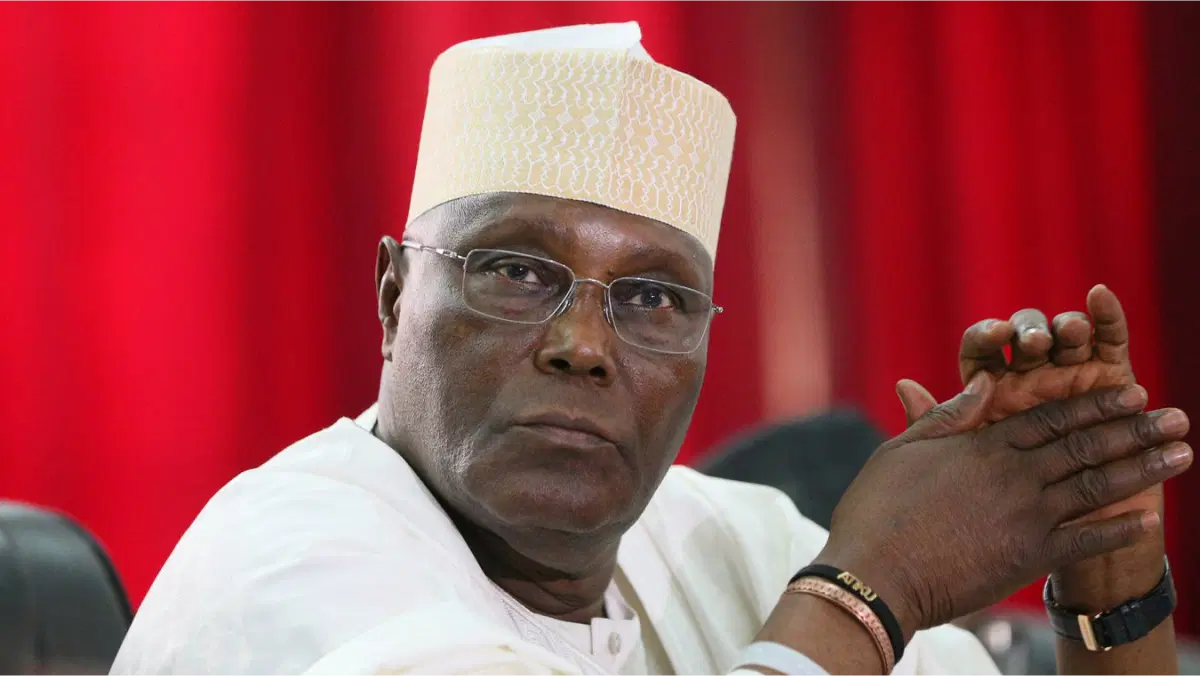
Nigeria Can’t Borrow or Tax Its Way to Prosperity, Says Atiku
By OUR REPORTER · 20/07/2026 3:33 PM · 3 min read
Former Vice President Atiku Abubakar has said Nigeria cannot achieve sustainable economic growth through borrowing and taxation alone, arguing that the country must focus on producing what it consumes, manufacturing what it uses and exporting what it creates.
Atiku said the country’s economic recovery depends on building a production-driven economy anchored on agriculture, manufacturing, solid minerals, technology and value addition.
The African Democratic Congress (ADC) presidential candidate for the 2027 election, in a statement issued by his Senior Special Assistant on Public Communication, Phrank Shaibu, said the hardship faced by Nigerians was not only due to global economic challenges but also linked to government policies.
According to him, current economic policies have encouraged consumption over production, importation over industrialisation and dependency over self-reliance.
“For too long, we have celebrated importation while neglecting production. We import food that should be grown in our fields, goods that should be manufactured in our factories and even raw materials that ought to be processed by Nigerian hands,” Atiku said.
“No nation has ever become prosperous by exporting jobs and importing poverty,” he added.
The former vice president highlighted rising food prices and pressures on local industries as signs of deeper structural problems in the economy.
He cited food inflation figures, stating that the national rate stood at 17.52 per cent, while figures were higher in some states, including Kogi State at 53.02 per cent and Niger State at 43.83 per cent.
Atiku also claimed that Nigerian manufacturers spent ₦3.53 trillion on imported raw materials within six months, warning that declining industrial activity could weaken economic growth and reduce employment opportunities.
“A nation cannot build prosperity when its factories are falling silent. We are exporting jobs, importing inflation, weakening the naira and mortgaging our future,” he said.
He argued that Nigeria must move away from dependence on imported goods and focus on strengthening domestic production capacity.
Atiku said a stronger Nigerian economy would require increased investment in agriculture, industrial production, technology and local processing.
He pointed to examples across different sectors, including cocoa processing in Ondo State, rice production in Kebbi, yam cultivation in Benue, tomato processing in Kano, pharmaceuticals in Aba, leather production in Kano and manufacturing in Nnewi.
According to him, expanding these sectors would create jobs, strengthen the naira and reduce dependence on imports.
“Every bag of cocoa processed, every bag of rice harvested, every tomato processed, every pharmaceutical produced and every machine assembled in Nigeria creates jobs and strengthens our economy,” he said.
Atiku said an ADC-led government would prioritise security for farmers and industrial operators, arguing that food security could not be achieved without protecting agricultural communities.
“Food security begins with farm security,” he stated.
He also referenced economic reforms introduced during the administration of former President Olusegun Obasanjo, where he served as vice president, saying those policies helped improve investor confidence, liberalise key sectors and attract private investment.
Atiku maintained that industries could not thrive in an environment of high borrowing costs, expensive energy, unstable currency and weak consumer purchasing power.
“Produce in Nigeria. Employ Nigerians. Consume Nigerian products. Export Nigerian excellence,” he said.
He added that the strength of nations is measured not by what they import, but by what they produce, process and export.
Written by
Our Reporter
SkyHigh NewsHub correspondent.