
Israel Launches Air Strikes in Lebanon as US-Iran Peace Deal Nears Completion
By SKYHIGHNEWSHUB · 13/06/2026 6:55 PM · 4 min read
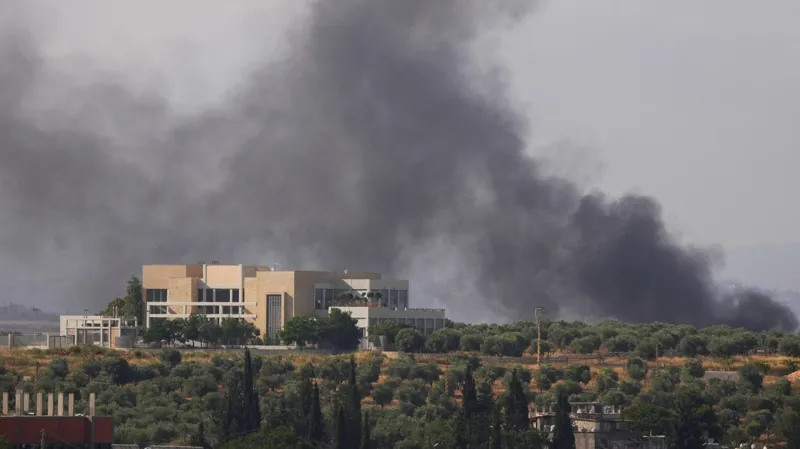
Israel carried out a series of air strikes in southern Lebanon on Saturday after ordering residents to evacuate around 20 locations, according to Lebanese state media.
The Lebanese National News Agency reported that at least one person was killed following a strike on the town of Marrakeh in the Tyre district.
The strikes came after Israeli Prime Minister Benjamin Netanyahu warned that Israel would continue military action against Hezbollah if attacks against northern Israeli communities persisted.
The escalation coincided with growing optimism surrounding negotiations aimed at ending hostilities between the United States and Iran.
Pakistan’s Prime Minister, Shehbaz Sharif, whose country has been mediating the talks, said negotiators were closer than ever to reaching an agreement, adding that finalisation was expected within 24 hours.
Iranian Foreign Minister Seyed Abbas Araghchi also stated that a deal to end fighting with the United States was near.
According to Araghchi, the proposed agreement would not only reopen the Strait of Hormuz but could also pave the way for an end to the conflict involving Israel and Hezbollah in Lebanon.
The Iranian foreign minister said the arrangement includes lifting the United States blockade of Iranian shipping and reopening the strategic waterway through which approximately 20 per cent of the world’s oil and liquefied natural gas normally passes.
Negotiations on Iran’s nuclear programme would begin at a later stage, he added.
United States officials have confirmed aspects of the proposed arrangement, noting that any economic benefits granted to Iran would depend on Tehran fulfilling its commitments.
Although reports from Washington had earlier suggested Lebanon might not be included in the framework, Iranian officials reportedly insisted on its inclusion.
The current conflict began on February 28 following US and Israeli strikes on Iranian targets. Iran subsequently responded with attacks against Israel and US-allied Gulf states while effectively shutting the Strait of Hormuz.
Despite agreeing to a ceasefire in April, Washington and Tehran have continued to exchange intermittent fire, including two rounds of retaliatory strikes this week.
President Trump disclosed on Thursday that he had cancelled planned attacks on Iran after negotiators reached what he described as a major breakthrough.
On Friday, Iranian media released details of a reported 14-point framework agreement. Trump, however, rejected the reports, insisting they bore no resemblance to the actual terms being discussed.
Pakistan later confirmed that the Memorandum of Understanding between the United States and Iran had been agreed and was awaiting final approval.
Sharif said preparations were underway for an electronic signing ceremony, which would be followed by technical-level discussions next week.
According to Iranian state media, Araghchi said there were both supporters and opponents of the agreement within Iran’s Supreme National Security Council, but no final collective decision had yet been reached.
“For now, we must wait. If approved, the agreement will be signed remotely,” he said.
Israel is not participating directly in the negotiations, which are intended to extend the ceasefire and establish a framework for discussions on key issues, including Iran’s nuclear programme.
For decades, Iran has denied accusations by Western governments that it seeks to develop nuclear weapons, maintaining that its nuclear programme is intended for peaceful purposes, including electricity generation and scientific research.
During a detailed briefing on Friday, US officials said the proposed agreement would reopen the Strait of Hormuz in exchange for the lifting of restrictions on Iranian shipping.
The arrangement would be followed by a 60-day negotiation period focused on Iran’s enriched uranium stockpiles. According to US officials, the process would eventually result in the destruction and removal of the material, although the precise mechanism remains under discussion.
Officials also stressed that no funds would be released to Iran in advance. Instead, sanctions relief and the possible unfreezing of assets would occur gradually as Tehran fulfils agreed obligations.
The proposed framework also calls on Iran to halt support for regional proxy groups, including Hezbollah and other allied organisations across the Middle East.
US officials said the agreement would be based on verified implementation rather than trust, with economic benefits tied directly to measurable compliance.
While negotiators from the United States, Iran, Pakistan and Qatar have expressed cautious optimism, officials acknowledge that several issues still require final resolution before the agreement can be formally concluded.
Araghchi nevertheless expressed confidence that a final announcement could come soon.
“As soon as the final stages of our negotiations are completed, this agreement will be signed and announced. This could happen in the coming days. I am very hopeful,” he said.
BBC
Written by
SkyhighNewshub
SkyHigh NewsHub correspondent.