
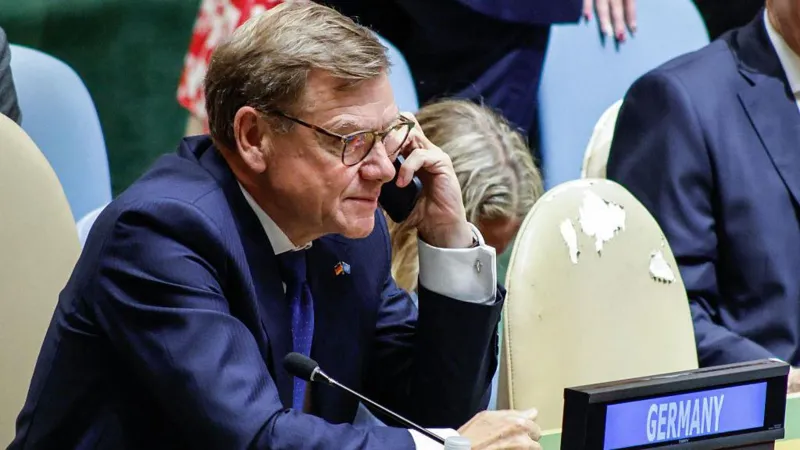
Germany Blames Russia After Shock Defeat in UN Security Council Election
By OUR REPORTER · 04/06/2026 9:04 AM · 2 min read
Germany has suffered a significant diplomatic setback after failing to secure a coveted seat on the United Nations Security Council, prompting accusations that Russia actively worked behind the scenes to undermine Berlin’s campaign.
German Foreign Minister Johann Wadephul described the outcome as a “bitter defeat” after Wednesday’s vote at the United Nations headquarters.
Germany secured 104 votes, falling short of rivals Portugal and Austria, which won 134 and 131 votes respectively to claim the two available seats allocated to Western European nations.
The result came as a surprise to many observers given Germany’s status as one of the world’s largest economies and one of the UN’s biggest financial contributors.
Reacting to the loss, Wadephul suggested that Berlin’s strong support for Ukraine in its war against Russia may have contributed to the outcome.
“There is our firm support for Ukraine. It is no secret that Russia does not want such a voice on the Security Council,” he said.
He also acknowledged that Germany’s unwavering support for Israel may have alienated some member states.
“The fact that Germany assumes a special responsibility toward Israel may also have cost votes,” he added.
Although no evidence has been publicly presented to support claims of Russian lobbying, German officials believe Moscow actively encouraged opposition to Berlin’s candidacy.
Russia has not formally responded to the allegations.
The Security Council remains the most powerful body within the United Nations system.
Its resolutions can authorize military action, impose sanctions and establish peacekeeping missions.
Five permanent members, United States, United Kingdom, France, Russia and China hold veto powers, while ten non-permanent members are elected for two-year terms.
The election also saw Kyrgyzstan, Trinidad and Tobago and Zimbabwe secure seats on the Council.
For German Chancellor Friedrich Merz, the defeat is likely to fuel criticism from political opponents who have questioned his ability to enhance Germany’s global influence.
Despite the setback, Merz sought to reassure allies that Germany would continue playing a leading role in multilateral diplomacy.
“This result does not alter the responsibilities before us. Germany remains a reliable pillar of the international system,” he said.
The outcome nevertheless represents one of Germany’s most significant diplomatic disappointments in recent years and raises questions about shifting geopolitical alliances within the United Nations.
Written by
Our Reporter
SkyHigh NewsHub correspondent.