
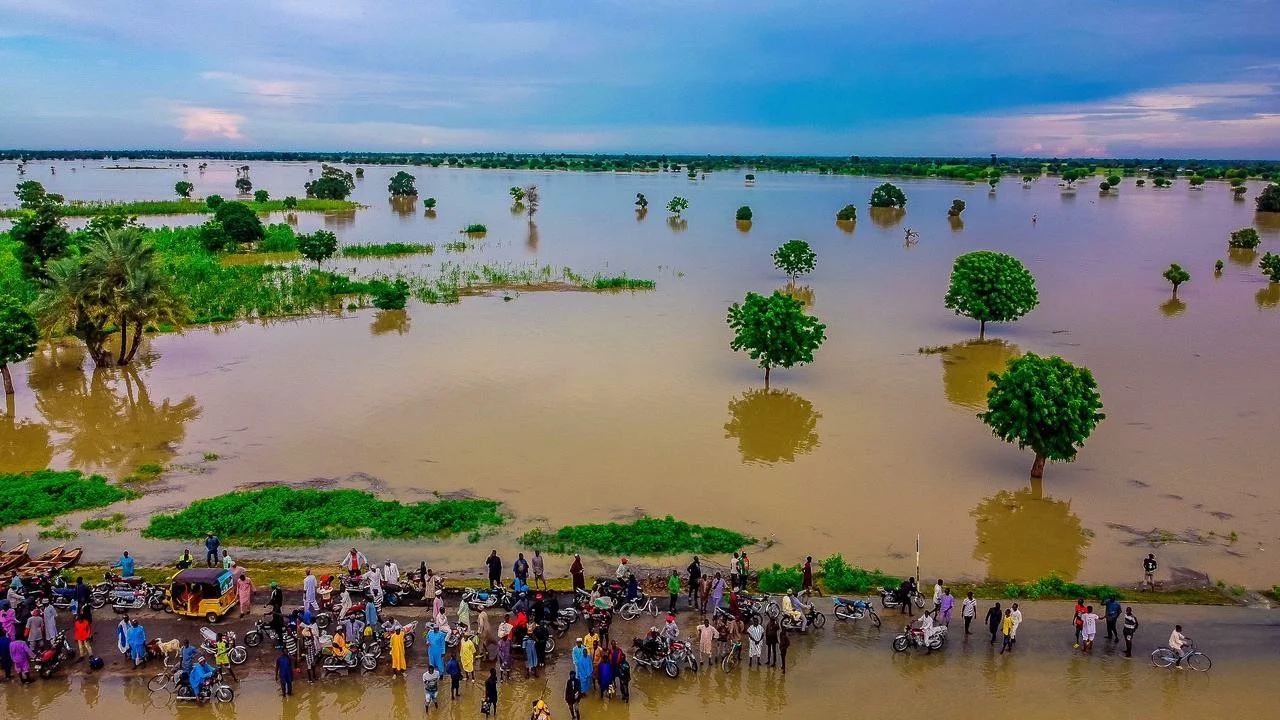
Flood Alert: NiHSA Says Over 18 Million Nigerians Face Flood Risk in 2026
By OUR REPORTER · 07/07/2026 3:15 PM · 3 min read
The Nigeria Hydrological Services Agency (NiHSA) has warned that more than 18 million Nigerians are at risk of flooding in 2026, as heavy rains continue to affect communities across the country.
The agency said its Annual Flood Outlook indicates that over 2,000 hectares of farmland, 8,794 educational facilities and 3,808 healthcare facilities are also vulnerable to flooding if adequate mitigation measures are not implemented.
The Director-General of NiHSA, Arc. Umar Mohammed, said the forecast was released early to enable state governments and relevant stakeholders to prepare and minimise the impact of the anticipated floods.
Represented by the agency's Head of Geographic Information System (GIS) and Remote Sensing, Emmanuel David Tuna, the Director-General explained that the projections cover the entire 2026 flood season.
"From our records, we are expecting about 18 million Nigerians to be exposed to flooding in 2026. Until the incidents occur, we cannot determine exactly who will be affected because these are predictive assessments based on scientific modelling," Tuna said.
He added that the forecast shows that more than 2,000 hectares of farmland could be submerged, while 8,794 educational institutions and 3,808 healthcare facilities are also located within flood-prone areas.
Providing further details, Tuna identified several high-risk locations expected to experience severe flooding during the year.
According to him, heavy flooding is anticipated along major river systems stretching from Sokoto to Kebbi, with Kebbi State projected to experience some of the most intense flooding.
He also warned that communities downstream of the Kainji Dam could be affected following expected water releases into the River Niger.
"We are expecting intense flooding around Niger State after the Kainji Dam. Following releases into the River Niger, parts of Kwara State, the Federal Capital Territory and Lokoja are also expected to experience significant flooding," he said.
Tuna further identified Onitsha in Anambra State, as well as Delta and Bayelsa states, among areas likely to be impacted by rising water levels.
He noted that Adamawa State, where the River Benue enters Nigeria, remains another major flood-prone area, with flooding expected to extend from the border through Jimeta and into Taraba State.
While Makurdi, the Benue State capital, is also expected to experience flooding, Tuna said the intensity there is projected to be lower than in several other high-risk locations.
He explained that the agency's flood outlook categorises flood risks into low, medium and high levels while also estimating expected flood depths to assist emergency planning and response.
Despite issuing annual forecasts, NiHSA expressed concern over what it described as poor cooperation from many state governments, saying repeated early warnings have often been ignored.
The Director-General lamented that some states fail to engage with the agency until floods have already occurred, undermining opportunities for preventive action.
"We have a serious challenge with cooperation from states. We issue these warnings well before flooding begins, but because there is no immediate danger at that time, many state governments do not take them seriously," he said.
Mohammed disclosed that NiHSA had developed a National Flood Insurance Programme designed to reduce the financial impact of flooding on affected communities through a metric-based insurance framework.
According to him, although the initiative was presented to several state governments, none has implemented the programme.
He also revealed that letters containing flood analyses and mitigation recommendations had been sent to several states without receiving responses or invitations for further engagement.
"We have all the scientific data regarding these floods and established communication channels. What we need is stronger engagement from state governments because flooding happens within communities, and the states are best positioned to implement preventive measures," he said.
The NiHSA boss stressed that while flooding cannot be completely eliminated, its devastating effects can be significantly reduced through early planning, proper drainage management, public awareness and coordinated action among all levels of government.
He, however, acknowledged that collaboration among federal agencies involved in disaster management remains strong, adding that the agency hopes state governments will strengthen their preparedness and response efforts as the flood season progresses.
Vanguard
Written by
Our Reporter
SkyHigh NewsHub correspondent.