
FG Discovers Major Platinum, Gold, Lithium Deposits In Kaduna, Seeks New Investments
By OUR REPORTER · 24/06/2026 8:24 PM · 4 min read
In a significant boost to Nigeria's mining and economic diversification ambitions, the Federal Government has announced the discovery of a world-class polymetallic mineral province in Kaduna State containing substantial deposits of platinum, gold, nickel, copper, lithium, rare earth elements and other strategic minerals.
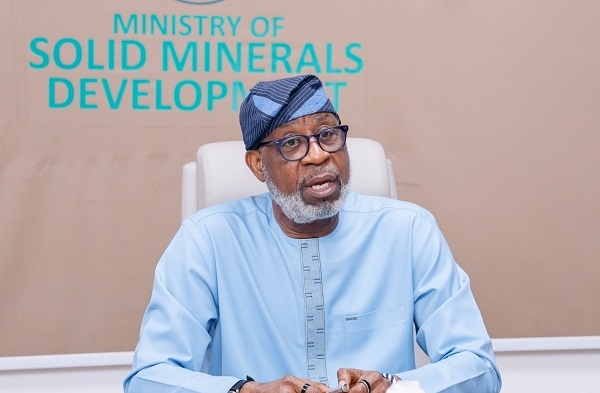
The Minister of Solid Minerals Development, Dr Dele Alake, disclosed the breakthrough on Wednesday at the 5th African Natural Resources and Energy Investment Summit (AFNIS 2026) in Abuja, describing it as one of the most important mineral discoveries in recent years.
According to the minister, the discovery was verified by the Nigerian Geological Survey Agency (NGSA) following extensive exploration activities and has the potential to reposition Nigeria as a major destination for critical minerals required for advanced manufacturing, clean energy technologies and the global energy transition.
"This is the first time I am announcing this publicly," Alake said.
"Recent exploration breakthroughs verified by our Nigerian Geological Survey Agency have unveiled a world-class polymetallic mineral province in Kaduna State, consisting of world-class platinum group metals, precious and critical mineral deposits."
He said the newly identified province contains significant deposits of platinum group metals, gold, nickel, copper, lithium and rare earth elements with exceptionally high grades.
The minister explained that the discovery was made by a private company working in collaboration with the NGSA, adding that the find further validates Nigeria's vast but largely underdeveloped mineral potential.
Alake said the discovery comes at a time of increasing global demand for critical minerals used in electric vehicles, battery storage systems, renewable energy infrastructure and advanced technologies.
According to him, Nigeria is positioning itself to become a strategic supplier of these minerals while ensuring greater value is retained within the country through local processing and industrial development.
He noted that the Tinubu administration has prioritised the solid minerals sector as a key pillar of its economic diversification agenda, introducing reforms aimed at attracting serious investors and improving sector governance.
"For too long, Nigeria's mineral endowment did not translate into sufficient national value," the minister said.
"That is precisely why the reforms we are implementing matter. We have focused on restoring discipline in licensing, strengthening compliance, improving transparency and ensuring that mineral assets are held by operators with the capacity and intention to develop them."
As part of ongoing reforms, Alake disclosed that the Federal Government has revoked more than 3,000 dormant and non-performing mineral titles.
He said the exercise was designed to discourage speculation, free up idle assets and ensure mining licences are held by investors prepared to develop them.
The minister also highlighted a policy requiring mining lease applicants to submit comprehensive value-addition plans before approvals are granted.
According to him, Nigeria is moving away from the traditional export of raw minerals toward domestic processing, refining and manufacturing.
"We want mining investments that lead to processing plants, refineries, industrial clusters, local jobs, technology transfer and stronger linkages with the wider economy," he said.
Alake said the government's value-addition policy has already begun attracting substantial investments into mineral processing projects across the country.
He cited an $800 million lithium processing investment, a $600 million lithium processing facility in Nasarawa State, a completed $200 million lithium processing plant near Abuja awaiting commissioning and another $50 million lithium refining project already in operation in the Federal Capital Territory.
The minister also referenced a $1 billion iron ore-to-steel project in Kogi State, describing such investments as critical to transforming the structure of Nigeria's economy.
Providing an update on sector performance, Alake said government revenue from mining increased from about N6 billion before the current administration assumed office to more than N38 billion in 2024 before exceeding N70 billion by the end of 2025.
"Our revenue performance has improved significantly," he said.
"You can see the geometric progression in revenue inflows from a sector that was generating barely N6 billion before these reforms."
The minister also urged African countries to adopt a coordinated approach to mineral development, arguing that the continent's future prosperity depends on stronger regional integration, value addition and industrialisation.
He said Africa must move beyond simply owning natural resources to developing a deliberate strategy for extracting greater economic value from them through processing, manufacturing and cross-border industrial partnerships.
Addressing investors, Alake reiterated that Nigeria remains open to credible partnerships that support local employment, technology transfer, community development and sustainable mining practices.
"Nigeria's message is direct and sincere: we are open for serious business," he said.
"We welcome investors who are ready to process locally, employ locally, train locally, transfer technology locally and build long-term value with us."
Written by
Our Reporter
SkyHigh NewsHub correspondent.